Chapter 15: Balance of Payments and Exchange Rate
Every economy that trades with the world faces a problem its home markets never pose. A household in Jaipur can buy from a shop in Delhi with rupees, but a refinery buying crude oil abroad must pay in dollars, because rupees are not accepted outside the country’s own boundary. Foreign currency is therefore a scarce resource, and a country can spend only what it earns by exporting, receives as remittances or borrows from abroad. Two questions follow from that scarcity. How much foreign currency did the country earn and spend over the year, and on what? The balance of payments answers this by recording, in one account, every economic transaction between the residents of a country and the residents of the rest of the world. At what price does one currency exchange for another? The exchange rate answers this, and in India it is settled largely by the demand for and the supply of foreign exchange in the market. This chapter explains the components and categories of the balance of payments, the causes of disequilibrium in it and the measures used to correct them, and how the exchange rate is determined in a free market.
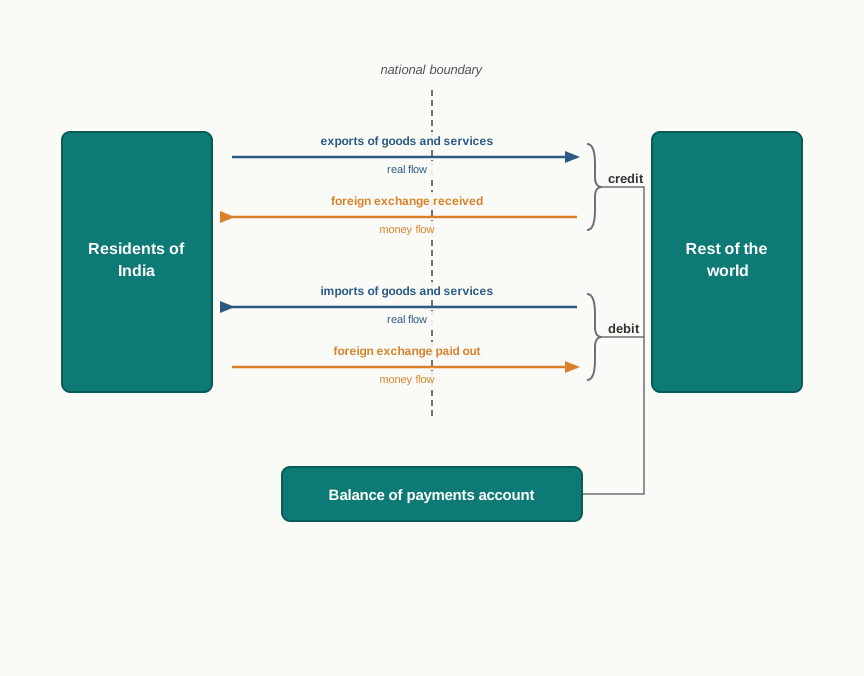
Fig. 15.0 – Receipts and payments between a country and the rest of the world.
15.1 Meaning of Balance of Payments
An economy does not stop at its own border. Firms sell goods abroad, households buy imported ones, workers send money home to their families, and investors move funds in and out of the country. Every one of these acts either brings foreign currency into the country or takes some out, and no single firm or family can see more than its own small part of the total.
A country therefore needs a measuring instrument of its own. It needs an account that gathers all such transactions into one statement and shows what the economy as a whole received from the rest of the world over a stated period and what it paid out. That account is the balance of payments.
15.1.1 Why a Country Records Its International Transactions
The account is not kept for the sake of book-keeping. It is kept because several decisions cannot be taken without it.
- Information on trade and capital flows — the account shows what a country sells and buys abroad and on what terms it borrows, lends and invests. It is the only complete picture of the external position available to the government and to the central bank.
- Basis of policy — monetary, fiscal and trade policy all rest on this record. A government that does not know why foreign exchange is leaving the country cannot judge whether to alter import duties, interest rates or the exchange rate.
- Warning of pressure ahead — a country that pays out more foreign exchange than it earns, year after year, must run down its reserves or borrow abroad. The account brings the drain to notice while it can still be corrected.
- Guidance for firms and investors — exporters, importers, banks and foreign investors read the account to judge whether a country is likely to face a shortage of foreign exchange, and they plan their own dealings accordingly.
15.1.2 Balance of Payments Defined
Two ideas hold the definition together. The first is that the record is systematic: every transaction is entered under a prescribed head, on a stated side, so that the account can be added up and compared with the account of an earlier year or of another country. The second is that the line is drawn between residents and non-residents, and not between pieces of territory.
A normal resident of a country is a person or an institution whose centre of economic interest lies in that country — who ordinarily lives, works and spends there. An Indian citizen employed in Dubai for several years is a resident of the United Arab Emirates for this purpose, so the money he sends to his family in Kerala is a transaction between a non-resident and a resident and enters India’s account. By the same test, foreign tourists, the staff of foreign embassies and international bodies such as the International Monetary Fund are not normal residents of the country in which they happen to be.
The period is stated because the account measures a flow. In practice a country reports for a financial year and, as India does, for each quarter within it.
15.1.3 Essential Features of Balance of Payments
The definition yields the features an answer on this topic must bring out.
- A systematic record — the transactions are not merely listed but classified, each under its proper head and on the receipts side or the payments side.
- Transactions between residents and non-residents — the account follows the residence of the parties, not the place where the goods happen to be sold.
- All economic transactions — flows of goods, of services and of assets are all covered, whether they are undertaken by private parties or by the government.
- Flows without a payment in return are included — a gift, a donation or money sent home by a worker abroad brings in purchasing power over foreign goods just as an export does, and is recorded even though nothing is given in return.
- A flow concept — the account relates to a period of time and shows movement during that period, not a stock held on any one date.
- Comprehensive coverage — current dealings in goods and services and capital dealings in assets are brought together in the same statement.
The fifth feature is the one most often mistaken. The account answers the question ‘how much moved during the year’, in the way an income statement does, and not the question ‘how much is held today’.
15.2 Components of Balance of Payments
A record of thousands of dealings is of no use until like is placed with like. The balance of payments is therefore built on two classifications, and both of them follow from the scarcity that made the account necessary in the first place.
The first classification asks what a transaction does to the country’s holding of foreign currency. Every dealing with the rest of the world either brings foreign currency in or takes some out, and that fixes the side of the account on which the item is entered. The second asks what kind of thing crossed the boundary. Goods, services and incomes are one kind; claims on assets are another. That fixes the account under which it is entered. The structure that results is set out in Fig. 15.1.
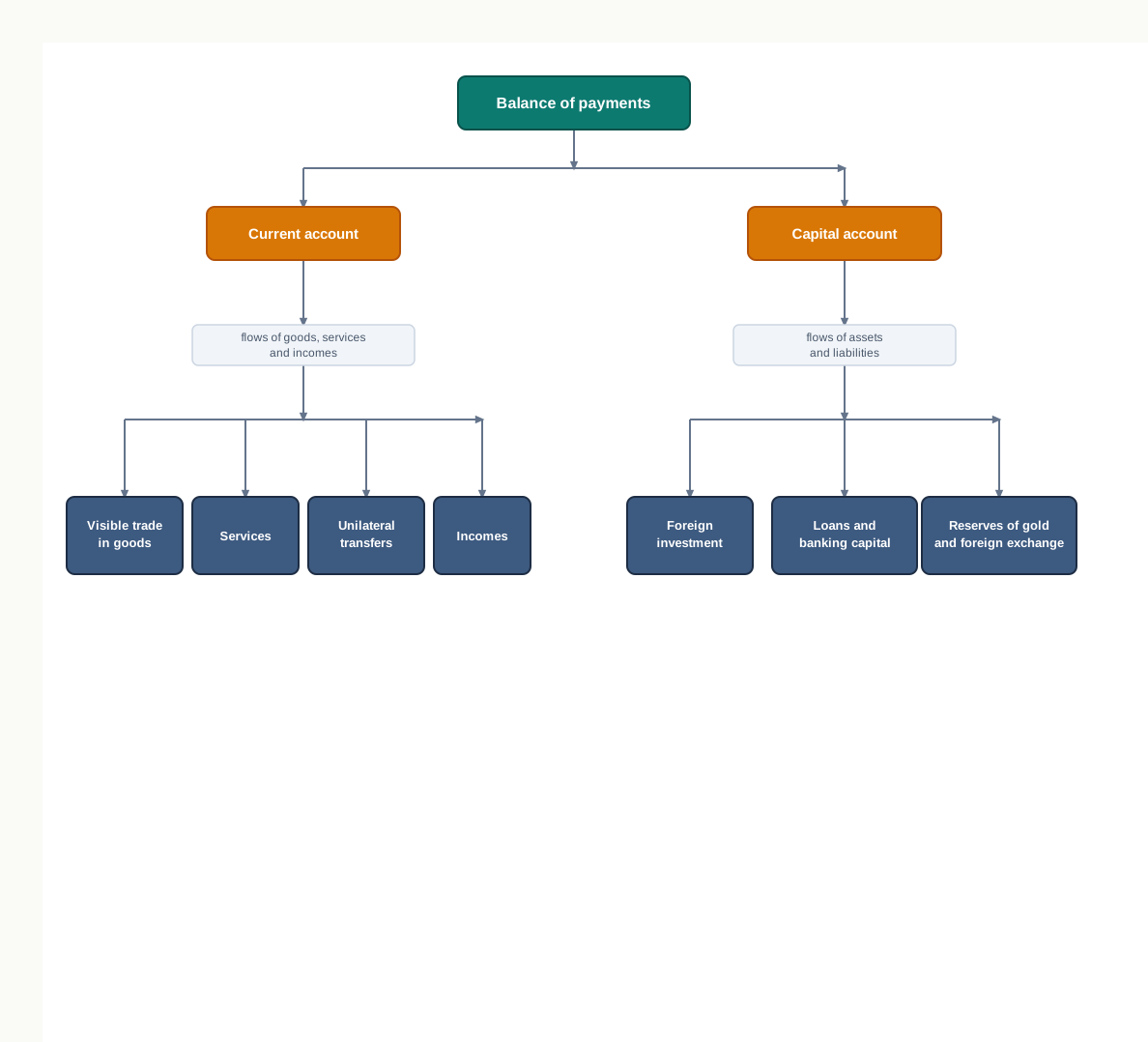
Fig. 15.1 – Structure of the balance of payments account.
15.2.1 Credit Items and Debit Items
The rule for the two sides is a single one. Any item that enables the country to acquire foreign currency is recorded as a credit, and any item that gives rise to the spending of foreign currency is recorded as a debit. Receipts from foreigners are credits; payments made by residents to foreigners are debits.
Read in that way, the credit side is a list of every route by which purchasing power over foreign goods reaches the country, and the debit side is a list of every use to which that purchasing power is put. The simplified format in Table 15.1 numbers the items so that they can be referred to later in the chapter.
15.2.2 Current Account Transactions
The items of the current account fall into four broad categories.
- Export and import of goods — this is visible trade, and it covers all physical goods that cross the boundary, such as tea, iron ore, machinery and cars. It is called visible because the goods are tangible and are seen and recorded when they pass the customs frontier. Exports appear as row 1 of Table 15.1 and imports as row 6.
- Export and import of services — services are the first of the invisibles, so called because nothing tangible crosses the boundary. Shipping, insurance, banking, business and software services and the spending of tourists all belong here. When a foreign tourist stays in India and pays for hotels and travel, the country earns foreign exchange and the amount is a credit in row 2; when an Indian family travels abroad, its spending is a debit in row 7.
- Unilateral transfers — these are receipts and payments made without anything being given in return, so there is no quid pro quo. Gifts, donations, charitable grants, indemnities and the money remitted by people settled abroad to their families are unilateral transfers. Receipts are entered in row 3, and the gifts, aid and indemnities the country itself gives to others in row 8.
- Incomes — incomes are of two sorts. Investment income is the interest, dividend and profit earned by residents on assets held abroad; compensation of employees is the wages and salaries earned by residents from non-residents. Both are credits in row 4. The interest and dividends paid to foreign lenders and investors, and the wages paid to non-residents, are debits in row 9.
Rows 1 to 4 and 6 to 9 together make up the current account. Every one of them is a flow expressed over a period of time, and every one of them bears directly on the level of income in the economy: what an exporter earns is income in his hands in the year in which he earns it.
15.2.3 Capital Account Transactions
Capital transactions do something different from current transactions: they alter what the country owns abroad and what it owes abroad. When residents borrow from abroad, the country is said to be importing capital, because foreign currency comes in and a liability is created, and the item is a credit in row 5. When residents lend or invest abroad, the country is exporting capital, because foreign currency goes out and an asset is acquired, and the item is a debit in row 10.
Capital movements take four main forms.
- Borrowing and lending — governments, firms and individuals may take loans from foreign governments, from foreign firms and individuals or from international institutions such as the International Monetary Fund and the World Bank, and may in turn lend abroad or repay loans taken earlier.
- Foreign investment — direct foreign investment is investment made in a firm abroad with a view to acquiring control over it, as when a foreign company sets up a plant in India or takes over an Indian firm. Portfolio investment is the purchase of shares of foreign companies or of bonds issued by foreign governments, with no control over management.
- Purchase and sale of assets — land, houses, plants and shares sold here to non-residents bring foreign exchange in, and the same kinds of asset bought abroad by residents take it out.
- Monetary movements — a change in the country’s stock of gold or in its reserve of foreign currency is entered here, since running reserves down is a way of paying and building them up is a way of holding a claim on the rest of the world.
The two accounts are best held apart by what each of them affects. The main points of difference are set out below.
15.2.4 Autonomous and Accommodating Transactions
A further division cuts across both accounts, and it is the one that decides whether a country is said to be in deficit at all.
Autonomous transactions are undertaken for their own sake, on ordinary economic grounds — to earn a profit, an interest or a dividend, or to obtain a good that is wanted. An American firm investing in India because it expects a return is acting autonomously. Such transactions take place whatever the state of the balance of payments, and they are said to be recorded above the line.
Accommodating transactions are undertaken for the sake of the account itself. They are made specifically to fill the gap the autonomous transactions have left, and their size is fixed by the size of that gap. If autonomous payments exceed autonomous receipts, the difference has to be met by drawing down the reserve of foreign exchange or by official borrowing from abroad. Such transactions are said to be recorded below the line, and they are almost always made by the government or the central bank.
15.3 Categories of Balance of Payments
The account set out in Table 15.1 answers a great many questions at once, and that is its weakness as well as its strength. A government wanting to know whether the country is living within its external means does not want ten rows; it wants a figure. It gets one by taking a group of items, adding the credits, adding the debits and striking the difference between the two. That difference is what is meant by a balance.
Which items are taken into the group decides which balance emerges. Take goods alone and the result is the balance of trade; add services, incomes and transfers and the result is the balance of current account; take the capital items and the result is the balance of capital account. The categories that follow are therefore not separate accounts but different ways of drawing the line, each answering a different question.
15.3.1 Balance of Trade
The narrowest of the balances looks only at goods — at the tangible things that pass the customs frontier. It is the difference between row 1 and row 6 of Table 15.1.
The balance of trade measures the earning and the spending of foreign exchange on merchandise alone. It compares the value of the goods a country sold abroad during the year with the value of the goods it bought.
\[\text{Balance of trade} = X_g - M_g\]
Here \(X_g\) is the value of goods exported during the year and \(M_g\) the value of goods imported, both measured in rupees at the prices at which the trade actually took place. The balance is itself a value, in ₹ crore, and not a ratio. A positive figure means that exports of goods exceed imports and the country has a surplus, or a favourable balance of trade. A negative figure means that imports exceed exports and the country has a deficit, or an unfavourable balance of trade.
There is no reason why the balance of trade should be nil. If a country’s exports of goods in a year are worth ₹6,00,000 crore while its imports are worth ₹8,00,000 crore, its balance of trade is a deficit of ₹2,00,000 crore, and that deficit has to be met from some other source of foreign exchange.
15.3.2 Balance of Current Account
Goods are only part of what a country sells and buys. The next balance therefore widens the group to take in everything that belongs to the current account — rows 1 to 4 against rows 6 to 9.
The balance of current account is the sum of three separate balances, each struck in the same way.
\[\text{Balance of current account} = \text{Balance of trade} + \text{Balance of invisibles} + \text{Balance of transfers}\]
Here the balance of invisibles is the excess of receipts over payments for services and for incomes such as interest, dividends and wages, and the balance of transfers is the excess of gifts and remittances received over those given. Each of the three balances, and therefore their sum, may be positive or negative, and the answer is again a value in rupees.
This is the balance that matters most for the level of activity at home. Its items are flows of currently produced goods and services and of the incomes arising from them, so a surplus adds to the incomes of residents, while a deficit means that the country has taken more from the rest of the world during the year than it has given it. These are also the items that respond quickly when the exchange rate changes.
15.3.3 Balance of Capital Account
The remaining pair of rows gives the third balance. It is the difference between row 5 and row 10 of Table 15.1.
\[\text{Balance of capital account} = \text{Capital receipts} - \text{Capital payments}\]
Capital receipts are the inflows recorded in row 5 and capital payments the outflows recorded in row 10, both measured in rupees. A positive figure means that the country has imported more capital than it has exported, and has thus either added to what it owes abroad or reduced what it holds abroad.
The balances of the two accounts are tied to each other, and the tie is one of arithmetic rather than of policy. A country whose current account is in deficit has spent foreign exchange that it did not earn on current transactions, and that foreign exchange must come from somewhere: it is borrowed abroad, or raised by selling assets to foreigners, or taken out of the reserves. Each of these is a credit in the capital account. A deficit on current account must therefore be settled by a net surplus on capital account, and a surplus on current account shows itself as a deficit on capital account, the country lending abroad or adding to its reserves.
15.3.4 Why Balance of Payments Always Balances
The balance of payments proper is the widest of the categories. It takes every item in Table 15.1 together, and includes all the debits and credits relating to all the items on account of which a country makes payments to and receives payments from the rest of the world.
Taken in that full sense, the balance of payments always balances. It is kept by double-entry book-keeping, so every international transaction is entered twice, once on each side. When a firm exports goods, the goods are credited; the foreign exchange received in return, whether held as a bank balance abroad, converted into rupees or used to buy an asset, is debited by exactly the same amount. Since the two entries are always equal, the total of the credit side must equal the total of the debit side, and the account cannot fail to balance in the accounting sense. In practice the entries are collected from many different sources, so a balancing item called errors and omissions is added to absorb the discrepancy between them.
The everyday statement that a country’s balance of payments is ‘in deficit’ is therefore a statement about a part of the account and not about the whole of it. It refers to the autonomous transactions. If autonomous receipts fall short of autonomous payments there is a deficit, and it is made good below the line by accommodating transactions — official borrowing or a fall in reserves. It is in this economic sense, and only in this sense, that a balance of payments can be said to be in surplus or in deficit.
The balance of trade and the balance of payments are often used as though they meant the same thing. The main points of difference are set out below.
15.4 Disequilibrium in the Balance of Payments
A country’s receipts from the rest of the world and its payments to it are settled by millions of separate decisions taken by exporters, importers, tourists, lenders and investors, at home and abroad, none of whom is trying to make the two totals agree. There is therefore no reason why they should agree, and in any given period they seldom do. When they do not, the balance of payments is in disequilibrium.
15.4.1 Meaning of Surplus and Deficit
Disequilibrium is measured on the autonomous transactions, for the reason given in Section 15.3.4: the accommodating transactions exist only to close whatever gap the autonomous ones have left, so counting them would conceal the very thing that has to be measured.
If autonomous receipts exceed autonomous payments, the balance of payments is in surplus, and the position is described as favourable. If autonomous receipts fall short of autonomous payments, it is in deficit, and the position is described as unfavourable or adverse.
A surplus is not usually a difficulty. A country earning more foreign exchange than it spends adds to its reserves or acquires claims on other countries, and it may do so for years together. A deficit is a difficulty, because it has to be financed as it arises. The reserves are finite, and a country that keeps borrowing to pay for its imports adds interest payments to next year’s debit side, which makes the following year’s deficit larger still. This is why the causes of an adverse balance and the remedies for it have to be studied together.
15.4.2 Causes of Adverse Balance of Payments
An adverse balance means either that too little foreign exchange is coming in or that too much is going out. The causes below are grouped by the route through which they work.
Causes Acting Through Trade
- Fall in foreign demand — foreign buyers may turn away from a country’s goods because tastes and fashions have changed, because rival countries are selling the same goods more cheaply, or because incomes abroad have fallen in a recession. Exports fall for reasons wholly outside the exporting country’s control, and receipts fall with them.
- Inflationary pressures in the economy — a high rate of inflation at home raises the prices of domestically produced goods relative to foreign ones. Imports become relatively cheap and rise, while exports lose their competitiveness in world markets and fall. The balance of payments is worsened from both sides at once.
- Rise in the cost structure of export industries — higher wages, dearer raw materials or a general rise in costs raise the price at which export industries can sell, and the volume of exports falls as buyers abroad turn to cheaper suppliers.
- Decrease in supply at home — a failure of crops, a strike or a shortage of power and raw materials reduces output. Less is available for export, and imports have to be increased to meet the scarcity at home, so the balance moves against the country on both counts.
- Appreciation of the exchange rate — when the external value of a country’s currency rises, its imports become cheaper in terms of domestic currency and its exports dearer in terms of foreign currency. Imports rise and exports fall, and the balance of payments becomes unfavourable.
Structural Causes In Developing Countries
- Developmental expenditure — a country in the early stages of development has to import machinery, equipment, raw materials and technical knowledge, and its import bill rises sharply. Its export capacity, however, grows only slowly, so the gap that opens is a lasting one and is called a structural deficit.
- Increased debt burden — capital borrowed earlier has to be serviced, and the interest and dividends paid abroad appear year after year on the debit side of the current account, quite apart from the repayment of the principal.
- Demonstration effect — people in developing countries tend to imitate the consumption patterns of richer countries, particularly in durable and luxury goods. Imports of such goods rise without any corresponding rise in the country’s capacity to export.
- Population pressure — a rapid increase in population raises the demand for all kinds of consumer goods. More of what is produced is used up at home, the exportable surplus shrinks, and imports of food and other necessities may have to be increased.
Political Causes
- Political factors — political instability and disturbed conditions drive away foreign investment and interrupt production and trade. Economic sanctions imposed on a country act in the same direction by closing its export markets and its access to foreign credit.
15.4.3 Measures to Correct Disequilibrium
A deficit can be attacked in four ways: by changing the price of foreign currency, by acting directly on trade, by reducing spending at home, or by financing the gap while the other measures take effect.
Measures Acting On The Exchange Rate
- Depreciation — under a flexible exchange rate system, a deficit itself raises the demand for foreign currency and so raises its price. Imports become dearer in terms of domestic currency and exports become cheaper in terms of foreign currency, so imports fall and exports rise until the deficit is wiped out. The adjustment is automatic and is examined in Section 15.7.
- Devaluation — under a fixed exchange rate system the same result has to be brought about by official action, the government reducing the external value of its currency by decision. Devaluation works only if the demand for exports and imports is fairly elastic; if buyers do not respond to the change in price, the country pays more for the same imports and earns no more from its exports.
Measures Acting Directly On Trade
- Import control — imports may be restricted by quotas, which limit quantity directly, or by higher tariffs, which raise the price of imported goods and reduce the quantity bought. A quota has a certain effect on quantity, while the effect of a duty depends on how buyers respond to the higher price.
- Export promotion — exports may be encouraged by reducing export duties, by cash assistance and subsidies, by tax exemption for goods meant for export, by quality control and market information, and by measures to attract foreign tourists. Exports, however, depend on demand conditions abroad, over which the home country has no control.
- Exchange control — the government may require all exporters to surrender their foreign exchange earnings to the central bank and all importers to buy foreign exchange from it. The available foreign exchange is then rationed among licence-holders, and essential imports can be given priority over luxuries. Prolonged exchange control encourages black-marketing in foreign currency.
- Production of import substitutes — goods that were being imported may be produced at home, which saves foreign exchange directly. If the industries so protected become efficient, they may in time become exporters themselves.
Measures Acting On Demand At Home
- Monetary policy — a tight monetary policy reduces total spending in the economy. The central bank raises the bank rate, sells securities in the open market and raises the cash reserve ratio; credit becomes dearer and scarcer, consumption and investment fall, and with them the demand for imported goods.
- Fiscal policy — a restrictive fiscal policy works on the same principle through the budget. Higher direct taxes reduce disposable income and consumption; a cut in government expenditure reduces demand directly. Both reduce the demand for imports, and the effect of fiscal measures on spending is more certain than that of monetary measures.
Financing The Gap
- Capital import — the deficit may be met in the short run by borrowing from foreign governments and individuals or from institutions such as the International Monetary Fund and the World Bank, and by drawing on Special Drawing Rights with the Fund. A country may also attract short-term private capital by raising its domestic rate of interest. These are temporary devices: they finance a deficit, they do not remove it.
15.5 Foreign Exchange and the Exchange Rate
Everything said so far about the balance of payments has been said in rupees, as though the account were settled in a single currency. It is not. An Indian exporter wants to be paid in rupees, because rupees are what he spends at home; his American buyer holds dollars. One of the two currencies has to be turned into the other before the transaction can be completed, and the terms on which that is done are as much a part of international trade as the price of the goods themselves.
Two things are therefore needed. There must be a market in which currencies can be bought and sold, and there must be a price at which one currency exchanges for another. This section explains what is traded in that market and how its price is expressed; how the price is settled is taken up in Section 15.7.
15.5.1 Meaning of Foreign Exchange
The currency of a country is generally accepted within its own boundary and, as a rule, nowhere else. A shopkeeper in New York will not take rupees, and an Indian importer cannot pay his supplier in Japan in rupees. Trade between nations is possible only because the currency of one country can be exchanged for that of another.
Foreign exchange is thus wider than currency notes. Most international payment is not made in notes at all but by transferring a bank balance held abroad, and a deposit, a cheque or a draft expressed in a foreign currency is foreign exchange just as the notes are. For India, United States dollars, pounds sterling, euro and yen are all foreign exchange; for the United States, the rupee is.
15.5.2 The Foreign Exchange Market
Foreign exchange is bought and sold like any other commodity, and the arrangement through which this is done is called the foreign exchange market.
The buyers and sellers in this market are individuals, firms, importers, exporters, foreign exchange brokers, commercial banks and the central banks of countries. Importers and those travelling or studying abroad come to it as buyers of foreign currency; exporters and the recipients of remittances come to it as sellers.
Like any market, the foreign exchange market is a system and not a place. There is no single building in which currencies change hands. Dealers in different countries are linked by telephone and by screens, so a rate quoted in one centre is known in all the others within moments, and the market is in operation somewhere in the world at almost every hour.
15.5.3 Meaning of Exchange Rate
The price at which the two currencies trade in that market is the exchange rate.
An exchange rate is a price like any other, but it is unusual in one respect: because it is the price of one currency in terms of a second, it can be quoted in either direction, and the two quotations say exactly the same thing. Suppose that one American dollar exchanges for ₹80. The rate may be written as the number of units of domestic currency needed to buy one unit of foreign currency, which is ₹80 for 1 dollar. It may equally be written as the number of units of foreign currency that one unit of domestic currency will buy.
\[\text{₹}1 = \dfrac{1}{80}\ \text{dollars} = 0.0125\ \text{dollars}\]
Here the 80 is the number of rupees given for one dollar, and the answer, 0.0125, is the number of dollars obtained for one rupee. Each figure is the reciprocal of the other, and neither is more correct than the other. It is customary in India to quote the rate in the first way, as so many rupees to a dollar, and that usage is followed throughout this chapter.
The direction of the quotation matters when a change is being described. If the rate moves from ₹80 to ₹84 for a dollar, the number quoted has risen, but what has risen is the price of the dollar: the rupee now buys less than it did. Reading the movement the wrong way round is the commonest error in this part of the syllabus.
15.6 Exchange Rate Systems
A price has to be settled by somebody. The rupee price of a dollar can be announced by the state and held there, or it can be left to the buyers and sellers who deal in the market. Which of the two a country chooses is its exchange rate system, and the choice decides a great deal — whether traders face a known rate or a moving one, how large a reserve the central bank must carry, and whether an external deficit corrects itself or has to be corrected.
There are two major systems, the fixed and the flexible, and most countries today work a compromise between them.
15.6.1 Fixed Exchange Rate System
Under the first system the rate is a decision, not an outcome.
Announcing a rate is not enough to hold it, and the announcement is only the beginning of the work. The central bank must stand ready to buy and to sell foreign currency at the declared rate against domestic currency. When there is an excess supply of foreign exchange in the market it buys the surplus, and when there is an excess demand it sells out of its own holdings. For this it must keep a reserve of foreign currencies, and the size of that reserve limits how long it can defend the rate.
A fixed rate is not frozen for all time. Depending on the circumstances and the state of the economy the central bank may revise it, but the revision is a policy decision taken deliberately, not a movement made by the market. Most countries, India among them, kept their currencies at fixed rates against one another from the end of the Second World War until the decade of the 1970s. The system gives traders and investors certainty about the rate they will face, which is its chief merit, and requires large reserves to defend, which is its chief difficulty.
15.6.2 Flexible Exchange Rate System
Under the second system the rate is an outcome, and the state stands back.
Here the central bank allows the rate to adjust until the demand for foreign exchange equals its supply, in the way the price of any commodity settles in a competitive market. How this happens is worked out in 15.7.
Floating is of two kinds.
- Clean floating — the central bank stands aside completely and allows the rate to be determined freely in the market. It does not intervene at all, and the rate is whatever demand and supply make it.
- Managed floating — also called dirty floating, this is the system under which the central bank intervenes, buying and selling foreign currencies in an attempt to influence the rate. It does not fix the rate; it normally enters the market only when the rate becomes unusually high or low.
Most countries today, including India, work a flexible system of the managed floating type. The two systems may now be set side by side.
15.6.3 Depreciation and Appreciation
Four terms are used for a change in the external value of a currency, and they are not interchangeable. Two belong to the flexible system, where the market moves the rate.
If the rupee depreciates against the dollar, Indians must pay more rupees for a dollar. A change in the rate from ₹75 for one dollar to ₹80 for one dollar is a depreciation of the rupee: the rupee has become less valuable against the dollar, and the dollar has become dearer in terms of rupees.
Appreciation is the mirror image. It means a rise in the free-market value of the domestic currency relative to other currencies, so that fewer units of it are needed to buy one unit of the foreign currency. A change from ₹80 for one dollar to ₹75 for one dollar is an appreciation of the rupee: India has to pay fewer rupees per dollar, and the rupee has become more valuable against the dollar.
15.6.4 Devaluation and Revaluation
The other two terms carry the same direction of change but belong to the fixed system, where the change is made by an act of policy.
After a devaluation the residents of the devaluing country must pay more of their own currency for foreign currencies, exactly as they must after a depreciation. In their effect on trade the two are the same, and devaluation is used synonymously with depreciation for that reason; what separates them is the system in force and the agency that brings the change about.
Revaluation is the opposite of devaluation. It is an action undertaken by the government or the central bank to raise the value of the domestic currency relative to other currencies under a system of fixed exchange rates, and it is therefore synonymous in its effects with appreciation. The four terms may now be set out together.
15.6.5 Effect of Exchange Rate Changes on Imports and Exports
A change in the rate does not touch the price of anything directly. What it changes is the price at which one currency converts into another, and that alters the prices of traded goods on both sides of the boundary at once.
Take a depreciation of the rupee first. A good priced abroad in dollars now costs more rupees than before, since more rupees must be paid for each dollar. Imports become dearer at home and the quantity imported falls. At the same time an Indian good priced in rupees now costs fewer dollars, because each dollar buys more rupees than before. Indian exports become cheaper for the foreign buyer and the quantity exported rises. Table 15.3 shows both effects on one imported and one exported article.
Reading down the table is reading a depreciation of the rupee. The spare part that cost ₹1,875 at ₹75 to the dollar costs ₹2,250 at ₹90, so Indian buyers order fewer of them; the shirt that cost the American buyer $8.00 costs him $6.67, so he orders more. Reading up the table is reading an appreciation, and every effect reverses: imports grow cheaper and rise, exports grow dearer and fall.
This is why depreciation and devaluation appeared in 15.4.3 among the measures for correcting an adverse balance of payments, and why appreciation appeared in 15.4.2 among the causes of one. The same movement in the rate that corrects a deficit worsens a surplus, and the same movement that makes exports competitive makes every imported input dearer for the industries that use them.
15.7 Determination of Exchange Rate in a Free Market
Since the system prevailing in most countries is the flexible one, the question that matters is how the rate settles when nobody fixes it. The answer uses the oldest tool in the subject. Foreign exchange is bought and sold like any other thing that is scarce and wanted, so its price is settled where the quantity demanded equals the quantity supplied.
To keep the argument clear the working model is one of two countries, India and the United States, trading with each other. Dollars are then the only foreign currency, and the exchange rate is the rupee price of a dollar, measured up the vertical axis of every diagram in this section. The quantity of dollars demanded and supplied is measured along the horizontal axis.
15.7.1 Demand for Foreign Exchange
The demand for foreign exchange arises because residents of a country need to make payments that can only be made in another country’s money.
- Import of goods and services — an importer buying machinery from the United States, or an Indian traveller spending abroad, must pay in dollars and must first buy them.
- Purchase of assets abroad — residents buying foreign shares, bonds or property need dollars to pay for them.
- Investment abroad — a firm setting up or acquiring a business in another country must convert rupees into the currency of that country.
- Gifts and grants sent abroad and repayment of foreign loans — both require foreign currency and neither brings any in.
The quantity demanded varies inversely with the exchange rate, and the reason lies in the price of imports. When the rupee price of the dollar is high, say ₹90 to a dollar, goods bought from the United States cost a great many rupees; Indian buyers order fewer of them and therefore need fewer dollars. When the rate falls to ₹75, the same goods cost fewer rupees, imports become attractive, and more dollars are demanded to pay for them. Plotted against the rupee price of a dollar, the demand curve for foreign exchange therefore slopes downward from left to right, as panel (a) of Fig. 15.2 shows.
How steep the curve is depends on the nature of the goods imported, on whether the country has industries that compete with those imports, and on the period allowed for adjustment. A country that imports luxuries and has well developed import-competing industries can cut its imports easily when dollars grow dear, and its demand curve for foreign exchange is elastic.
15.7.2 Supply of Foreign Exchange
The supply of foreign exchange arises from the reverse set of dealings — the ways in which foreigners’ money comes into the country and has to be converted into rupees.
- Export of goods and services — exporters earn dollars and bring them to the market to be exchanged for the rupees in which their own costs are met.
- Spending by foreign visitors — money spent in India by people from abroad must first be converted into rupees.
- Remittances and transfers received — funds sent to residents from abroad add to the dollars offered in the market.
- Foreign investment and borrowing — dollars brought in by foreigners buying Indian shares and bonds, or setting up business here, and loans raised abroad, are all offered for rupees.
The quantity supplied varies directly with the exchange rate. When the rupee price of the dollar rises from ₹75 to ₹90, an Indian good priced in rupees costs the American buyer fewer dollars, as Table 15.3 showed; exports become cheaper for him, he buys more, and more dollars are earned and offered in the market. The supply curve of foreign exchange therefore slopes upward from left to right, as panel (b) of Fig. 15.2 shows.
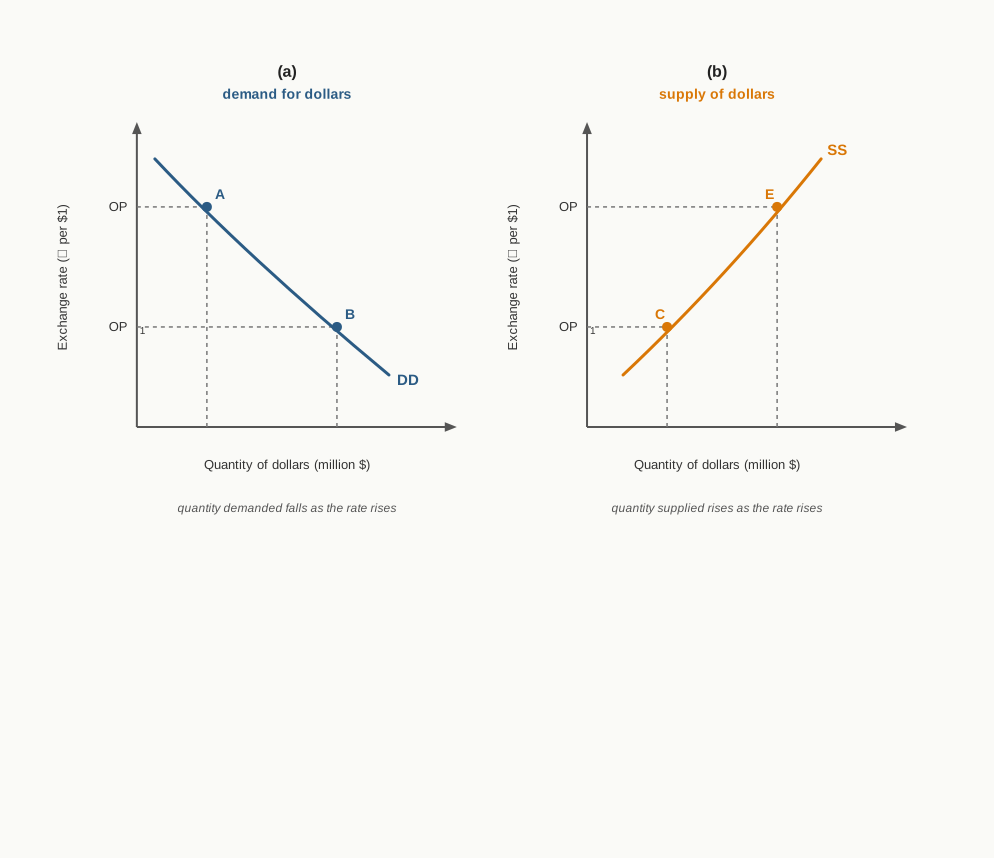
Fig. 15.2 – Demand and supply curves of foreign exchange.
15.7.3 The Equilibrium Exchange Rate
Bringing the two sides together settles the rate. Table 15.4 sets out the quantity of dollars demanded and supplied at four rates.
At ₹80 to a dollar the two quantities are equal at 400 million dollars, and that rate alone can persist.
What happens at any other rate explains why. Fig. 15.3 places the two curves on one diagram, with equilibrium at \(E_0\) and the equilibrium rate \(r_0\).
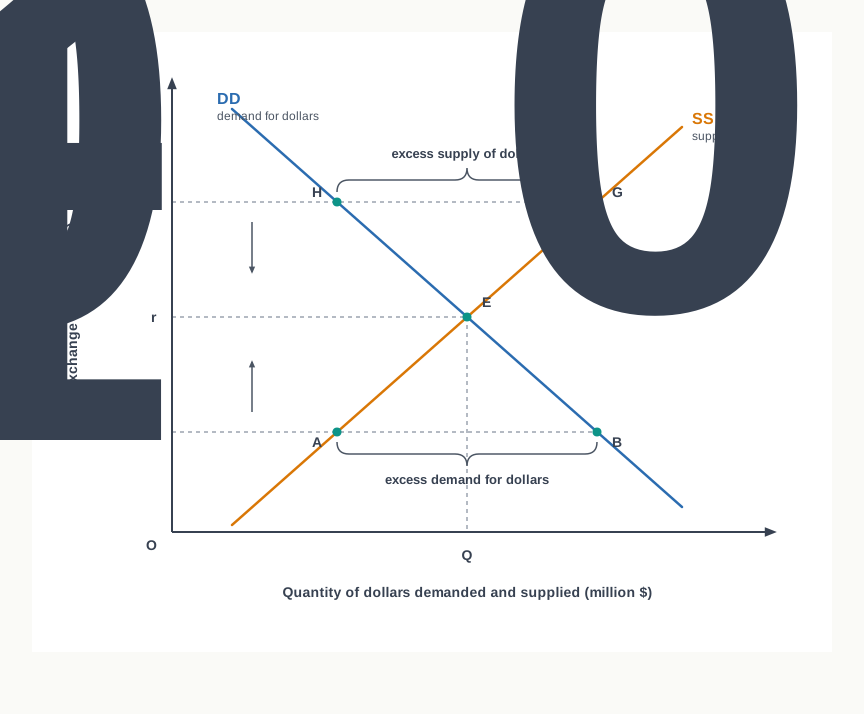
Fig. 15.3 – Determination of the equilibrium exchange rate.
At the low rate \(r_1\) dollars are cheap in terms of rupees, imports are attractive, and the demand for dollars exceeds their supply by the amount AB. Some of those who need dollars to make payments in the United States cannot obtain them, and they bid the price up. As the rupee price of the dollar rises, the quantity demanded falls and the quantity supplied rises, and the excess is squeezed out until the rate reaches \(r_0\).
At the high rate \(r_2\) the position is reversed. Dollars are dear, imports are unattractive and exports are cheap for the foreign buyer, so the supply of dollars exceeds the demand by GH. Holders of dollars who cannot find buyers accept less for them, the rate falls, and the market again moves to \(r_0\). The rate that survives is the one at which every dollar offered finds a buyer.
15.7.4 Changes in the Equilibrium Exchange Rate
The equilibrium rate holds only as long as the conditions behind the two curves hold. When either curve shifts, the rate moves to a new equilibrium, and it is this movement that makes the flexible system a system of automatic adjustment.
Suppose a country in external balance begins to import more, or its residents invest more abroad. The demand for foreign exchange rises at every rate and the demand curve shifts to the right, from DD to \(D_1D_1\) in Fig. 15.4. At the old rate \(r_0\) there is now an excess demand for dollars equal to \(E_0K\) — a deficit in the balance of payments. The rate is bid up to \(r_1\), which is a depreciation of the rupee, and the depreciation itself does the correcting: imports become dearer and are cut back, exports become cheaper and rise, until the excess demand is wiped out at the new equilibrium \(E_1\).
A surplus is corrected the same way in reverse. If exports rise, the supply of dollars increases at every rate and the supply curve shifts to the right, from SS to \(S_1S_1\). At the old rate there is an excess supply equal to \(E_0L\), the rate falls to \(r_2\), the rupee appreciates, imports become cheaper and rise while exports become dearer and fall, and the surplus disappears at \(E_2\).
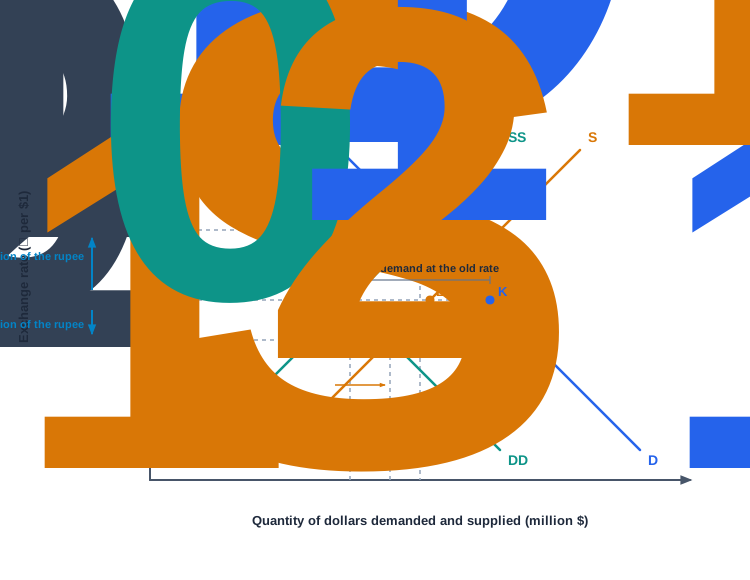
Fig. 15.4 – Change in the equilibrium exchange rate.
The forces that move the curves can be listed, and each is a cause of a change in the rate.
- Factors raising the demand for foreign exchange — an increase in imports, greater investment abroad, inflation at home that makes foreign goods relatively cheap, and disturbed economic conditions that send capital out. Each shifts the demand curve to the right and raises the exchange rate, depreciating the domestic currency.
- Factors raising the supply of foreign exchange — an increase in exports, larger foreign investment coming in, loans raised abroad, a rise in interest rates at home that attracts foreign funds, and conditions of peace and security in the country. Each shifts the supply curve to the right and lowers the exchange rate, appreciating the domestic currency.
A flexible rate is therefore an elegant arrangement. It solves the problem of disequilibrium in the balance of payments without any concerted effort, since the price of foreign exchange moves of its own accord until the quantity wanted equals the quantity offered — which is the same thing as saying until the country’s autonomous payments equal its autonomous receipts.
15.8 Summary
- Foreign currency is scarce, and a country needs one account that shows what it earned from the rest of the world and what it paid out. That account is the balance of payments — a systematic record of all economic transactions between the residents of a country and the residents of foreign countries during a given period, usually one year.
- Its essential features are:
- It is a systematic record, every item classified under its proper head and side.
- It records transactions between residents and non-residents, a normal resident being one whose centre of economic interest lies in the country.
- It covers all economic transactions, including flows such as gifts and remittances for which nothing is given in return.
- It is a flow concept relating to a period of time, and not a balance sheet drawn on a single date.
- Every item is entered on one of two sides. An item that enables the country to acquire foreign currency is a credit, and an item that gives rise to the spending of foreign currency is a debit.
- The current account records dealings of the period itself and is made up of four categories:
- Export and import of goods, together called visible trade.
- Export and import of services such as shipping, banking, insurance, software and tourism.
- Unilateral transfers, for which there is no quid pro quo.
- Income, namely investment income and compensation of employees.
- Services, transfers and income together are called invisible items. The capital account records transactions that change the country’s foreign assets and liabilities — foreign investment, loans and repayments, banking capital and movements in official reserves. Borrowing from abroad is called import of capital and is a credit; investing abroad is export of capital and is a debit.
- Foreign investment is of two kinds: direct foreign investment, made to acquire control over a firm abroad, and portfolio investment, made in shares and bonds for the return alone, without control.
- Autonomous transactions are undertaken for ordinary economic reasons and lie above the line; accommodating transactions are undertaken to fill the gap left by them and lie below the line. Surplus and deficit are judged on the autonomous transactions alone.
- Balance of trade is the difference between the value of visible goods exported and imported in a year, \(\text{BOT} = X_g - M_g\), where \(X_g\) is the value of goods exported and \(M_g\) the value of goods imported, both in rupees. A positive figure is a favourable balance or surplus, a negative one an unfavourable balance or deficit.
- Balance of current account adds to the trade balance the balances of the two invisible heads, \(\text{BCA} = \text{BOT} + B_i + B_t\), where \(B_i\) is the balance of invisibles and \(B_t\) the balance of unilateral transfers, each a money amount for the same year.
- Balance of capital account is the difference between capital receipts and capital payments, \(\text{BKA} = R_k - P_k\), where \(R_k\) is borrowing, sales of assets and repayments received and \(P_k\) is lending, purchases of assets abroad and repayments made. A current account deficit must be settled by a net surplus on capital account.
- Balance of payments is the sum of the two, \(\text{BOP} = \text{BCA} + \text{BKA}\), and in the accounting sense it always balances, because the account is kept by double entry and every transaction is entered on both sides. A country is nevertheless in deficit when its autonomous receipts fall short of its autonomous payments.
- The main causes of an adverse balance of payments are:
- Fall in foreign demand and increase in the cost structure of export industries, both of which reduce exports.
- Inflationary pressures at home, which raise imports and reduce exports together.
- Developmental expenditures, which raise the import bill and create a structural deficit.
- Decrease in domestic supply, appreciation of the exchange rate and a rising debt burden.
- The demonstration effect, population pressure and political factors such as instability and sanctions.
- The main measures for correcting a deficit are:
- Exchange rate measures — depreciation under a flexible system and devaluation under a fixed one.
- Trade measures — import control by quotas and tariffs, export promotion, exchange control and production of import substitutes.
- Expenditure measures — a tight monetary policy and a restrictive fiscal policy, both of which reduce total spending and so reduce imports.
- Capital import, including the use of Special Drawing Rights, which meets the deficit but does not remove its cause.
- Foreign exchange means foreign currencies and claims on them in the form of bank deposits, cheques and similar instruments payable in those currencies. The foreign exchange market is the market in which foreign exchange is traded, and it is a system of dealings among importers, exporters, banks, brokers and central banks rather than a place.
- The exchange rate is the rate at which the currencies of different countries are traded, that is the price of one currency in terms of another. It may be quoted as rupees per dollar or as dollars per rupee, the two being reciprocals, \(e_r = \dfrac{1}{e_f}\), where \(e_r\) is the number of rupees needed to buy one dollar and \(e_f\) the number of dollars one rupee will buy. India uses the first form.
- Under a fixed exchange rate system the rate is fixed by the central bank by official action and does not vary with demand and supply; the bank must hold reserves and buy and sell at the declared rate to hold it. Under a flexible or floating system the rate is left free to be determined in the market by demand and supply.
- Floating is clean when the central bank stands aside completely, and managed or dirty when it intervenes to influence the rate. Most countries, India among them, work a managed float.
- Depreciation is a fall and appreciation a rise in the free-market value of the domestic currency under a flexible system; devaluation is a fall and revaluation a rise brought about by official action under a fixed system. Depreciation and devaluation make imports dearer at home and exports cheaper abroad, so imports fall and exports rise; appreciation and revaluation do the reverse.
- The demand for foreign exchange arises from imports, purchases of assets abroad, investment abroad and transfers sent out, and it varies inversely with the exchange rate, because a higher rupee price of the dollar makes imports dearer. The supply arises from exports, spending by foreign visitors, transfers received and capital coming in, and it varies directly with the rate, because a higher rupee price of the dollar makes Indian goods cheaper for the foreign buyer.
- The equilibrium exchange rate is the rate at which the demand for foreign exchange equals its supply. Below it there is excess demand and the rate is bid up; above it there is excess supply and the rate falls.
- A rightward shift of the demand curve raises the rate and depreciates the currency, and a rightward shift of the supply curve lowers the rate and appreciates it. Because the depreciation itself cuts imports and raises exports, a flexible exchange rate is a system of automatic adjustment of disequilibrium in the balance of payments.
The four balances struck on the account may be compared in one view.
15.9 Points to Ponder
- A country with a deficit can let its currency fall, which works on prices, or it can control imports by quota, which works on quantities. Which of the two places the heavier burden on ordinary households, and does your answer change if most of what the country imports are things it cannot do without?
- The demand curve for foreign exchange is drawn sloping downward because dearer imports mean fewer imports. How far does that hold for a country whose import bill is made up largely of fuel, fertiliser and industrial components? If it does not hold, what happens to the claim that a flexible rate corrects a deficit automatically?
- The balance of payments always balances in the accounting sense, and yet countries have balance of payments crises. Is the statement ‘the balance of payments must always balance’ a useful piece of economics, or one that conceals more than it explains?
- If a freely floating rate solves the problem of external disequilibrium without any concerted effort, why do almost all countries operate a managed float and hold large reserves of foreign exchange instead of standing aside completely?
- A current account deficit met by foreign borrowing is a country spending more than it earns and using the savings of the rest of the world. When is that a sensible way to build capacity that will earn foreign exchange later, and when is it only postponing an adjustment that will have to be made on harder terms?
- Some countries pay for a large deficit in goods out of what they earn from services and from citizens working abroad. Both sources depend on demand in other countries. Is an economy that finances its imports in this way more secure than one that earns the same amount by exporting goods, or less?
15.10 Objective Questions
- Which of the following items is recorded on the credit side of a country’s balance of payments? [1]
- Import of machinery from abroad
- Borrowing from a foreign bank
- Purchase of shares of a foreign company by a resident
- A gift sent by a resident to a relative living abroad
- Read the assertion and the reason given below and choose the correct option. [1] Assertion (A): Under a flexible exchange rate system a deficit in the balance of payments tends to correct itself. Reason (R): The excess demand for foreign exchange raises the exchange rate, which makes the country’s exports cheaper for foreign buyers and its imports dearer at home.
- Both A and R are true, and R is the correct explanation of A.
- Both A and R are true, but R is not the correct explanation of A.
- A is true but R is false.
- A is false but R is true.
- Fill in the blank: The capital transactions undertaken specifically to fill the gap left by a country’s ordinary economic dealings with the rest of the world are called ________ transactions. [1]
- State whether the following statement is true or false: A rise in the number of rupees required to buy one United States dollar is an appreciation of the rupee. [1]
- Match each item in Column I with the correct item in Column II. [1]
| Column I | Column II |
|---|---|
| a. A rise in the value of the domestic currency brought about by official action under a fixed exchange rate system | i. Balance of trade |
| b. The difference between the value of visible goods exported and imported in a year | ii. Revaluation |
| c. A floating system in which the central bank intervenes only to moderate movements in the rate | iii. Managed floating |
15.11 Check Your Concepts
- Distinguish between the balance of trade and the balance of current account. [2]
- Explain any three causes of an adverse balance of payments of a country, stating in each case whether the cause works through exports or through imports. [3]
- Distinguish between depreciation and devaluation of a currency, and explain how a fall in the external value of a country’s currency affects its imports and its exports. [4]
- ‘The flexible exchange rate system is a system of automatic adjustment of disequilibrium in the balance of payments.’ Explain this statement with the help of a suitable diagram. [6]
15.12 Case-Based Question
- Meera Nambiar runs Kadal Exports, a firm in Kochi that sells packaged seafood to buyers in the United States and imports its freezing equipment from an American manufacturer. Her export prices are fixed in rupees and the equipment is priced in dollars. Over the past year the exchange rate has moved from ₹80 to ₹86 for one United States dollar.
- Explain what this change does to the dollar price of Meera’s seafood in the United States, and what her buyers there are therefore likely to do. [2]
- Meera says the same change has made her next purchase of freezing equipment harder. Explain why, and state the account and the side of India’s balance of payments on which that purchase is recorded. [2]