Chapter 16: Fiscal Policy
Every year on 1 February the Union Finance Minister rises in Parliament to present the Budget for the coming financial year. The document sets out how much the government proposes to spend, how much it expects to collect in taxes, and how much it must borrow to cover the gap. Behind those three numbers lies an economic problem. A government has ends without limit — defence, roads, schools, hospitals, pensions — and means that are scarce. Every rupee it raises comes out of somebody’s income, and every rupee it spends is a claim on resources the private sector could have used. Fiscal policy is the name economics gives to the deliberate handling of that choice: the use of taxation, public expenditure and public borrowing to shape the level of income, output, employment and prices in an economy. This chapter builds the vocabulary needed to read that Budget — public revenue, public expenditure, public debt and deficit financing — and shows how a government uses each of them to pursue stability, growth and a fairer distribution of income. It begins with the scope of public finance and ends with fiscal policy at work.
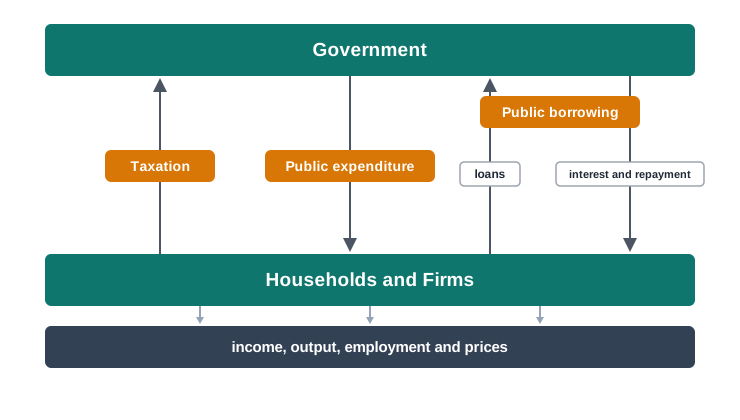
Fig. 16.0 – The three instruments of fiscal policy.
16.1 Public Finance: Meaning and Scope
A modern government is expected to do a great many things at once. It maintains law and order, provides defence, builds roads, ports and power lines, runs schools and hospitals, pays pensions and undertakes investment meant to speed up economic development. None of this is costless. Every function has to be paid for, and the resources used are drawn from the same limited pool that households and firms are drawing on.
Large funds are therefore needed, and the government raises them in several ways: by levying taxes, by charging fees for the services it renders, by selling the goods and services produced by its own enterprises, by taking the interest, dividends and profits earned on what it owns, and by borrowing. How these funds are raised, and how they are then spent, is the subject matter of public finance.
The expression public authorities is deliberately wide. It covers every tier of government — municipal boards and other local bodies, district boards, state governments and the central government. Whenever a body of this kind raises money from the public and spends it on the public’s behalf, its finances belong to the subject.
Two flows are therefore studied together. On one side stands the income of public authorities; on the other stands their expenditure. Neither can be judged on its own, because the size of the one governs what is possible in the other, and it is the adjustment of the one to the other that the subject is really about.
The Scope Of Public Finance
The subject is conventionally studied under four heads, each of which asks a different question.
- Public revenue — where the money comes from: the tax and non-tax receipts of the government, the types of taxes and the principles on which the burden of taxation is distributed among different classes.
- Public expenditure — where the money goes: the classification of government spending and its effects on production, investment, the distribution of income and the rate of growth.
- Public debt — what happens when revenue falls short: the reasons for which a government borrows, the forms its borrowing takes and the methods by which the debt is finally repaid.
- Fiscal policy — how the first three are used: the deliberate handling of taxation, spending and borrowing to reach the objectives the government has set itself.
The fourth head is what turns public finance from an account of receipts and payments into a branch of economics. The subject deals not only with the fiscal operations of public authorities — the actual collection of revenue and incurring of expenditure — but also with the fiscal problems that arise from them and the policies adopted to meet those problems. Fiscal operations, fiscal problems and fiscal policy are all integral parts of public finance.
The four heads and their relation to one another are set out in Fig. 16.1.
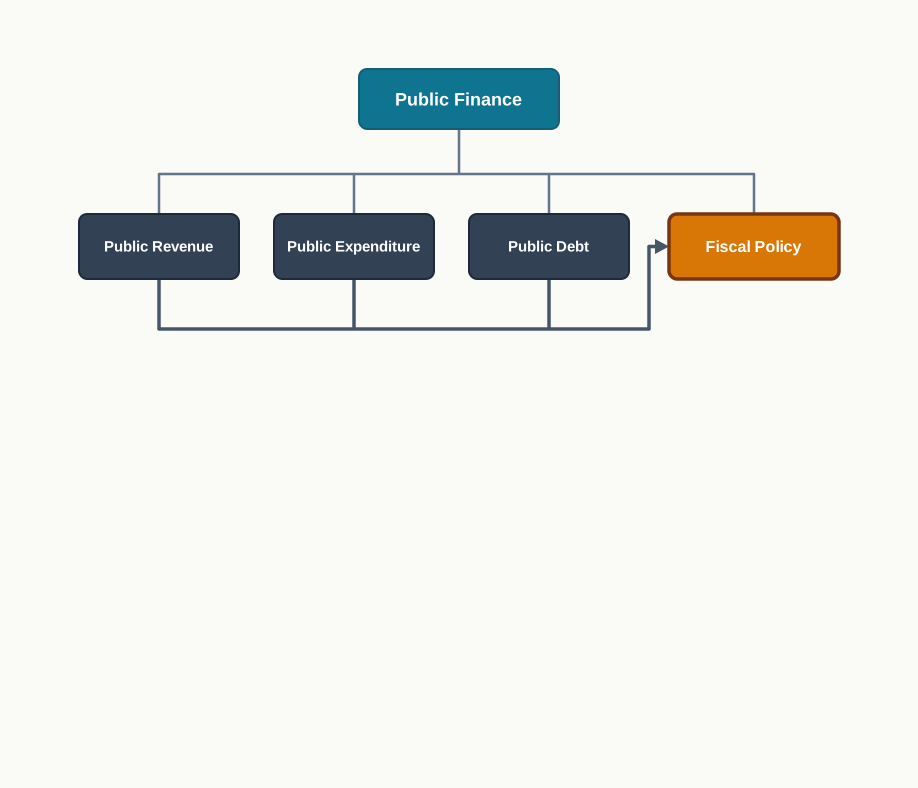
Fig. 16.1 – The scope of public finance.
Seen this way, public finance is the economics of a particular kind of choice. The wants of the community are unlimited and the resources available to satisfy them are not, so a government that spends more under one head must either spend less under another, tax more heavily or borrow. The rest of the chapter takes the three instruments in turn and then puts them to work.
16.2 Fiscal Policy: Meaning, Objectives and Instruments
A government that collects a rupee in tax and spends it has not merely balanced a book. It has taken purchasing power out of one set of hands and placed it in another, and in doing so it has altered the demand for goods, the level of output and, in time, the number of people at work. Once that is seen, taxing and spending cease to be administrative acts and become instruments of policy.
16.2.1 Meaning of Fiscal Policy
The policy of the government with regard to public revenue, public expenditure and public borrowing is what economics calls fiscal policy. The government must in any case collect revenue and incur expenditure; fiscal policy is the decision to vary the size, the composition and the timing of both in order to produce a chosen effect on the economy.
Two things in that definition matter. The first is that fiscal policy is deliberate: it is not what happens to the government’s accounts but what the government chooses to do with them. The second is that its target lies outside the accounts altogether — the level of income, production, employment and prices in the economy as a whole.
Fiscal policy was not always regarded in this way. For a long time a government was expected simply to balance its budget, spending no more than it raised, and the state of the economy was thought to be no business of the treasury. The significance of fiscal policy as an instrument of economic policy was first emphasised in the mid-1930s by Keynes, who showed that when private spending is deficient the government can raise the level of economic activity by spending more than it takes away.
The three tools work on the economy in different ways. Taxation reduces the disposable income of households and the funds left with firms, and so restrains private spending. Public expenditure adds directly to the demand for goods and services and to the incomes of those who supply them. Public borrowing settles who gives up purchasing power to cover the gap between the two. A good fiscal policy is one that combines the three in the proportions the situation requires, rather than one that leans on any single tool.
16.2.2 Objectives of Fiscal Policy
The objectives of fiscal policy are the objectives of economic policy generally, and they differ from country to country according to the level of economic development. In a developed economy the main concern is to keep a high level of activity steady; in a developing economy it is to raise that level in the first place. The main objectives are as follows.
- Economic stability — economic activity should be maintained at a stable level, without violent fluctuations in output and employment. Market economies pass through business cycles of alternating booms and depressions. In a boom output and employment are high but prices rise sharply; in a depression output and employment are very low and unemployment is severe. Fiscal policy is used to check the swing at both ends.
- Full employment — every person willing to work at the existing wage rate should be able to find work. Attaining this objective means that the economy is producing the maximum output its available resources allow, so unemployment is a waste of resources as well as a hardship.
- Economic growth — the real per capita income of the country should rise over a long period. Growth enables the economy to produce more goods and services and so to raise the standard of living, and a higher rate of growth is the most dependable way of reducing poverty and unemployment in a developing country like India.
- Price stability — the general price level should change only within a modest range. Prices are not expected to stand still; a mild rise is unavoidable in a growing economy and acts as a stimulant to production. What has to be prevented is a steep and continuous rise, because it eats into the real income of those whose money incomes are fixed and redistributes wealth arbitrarily.
- Reduction of inequalities in income and wealth — the benefits of development should be shared. Where a majority struggles to make both ends meet while a small number lives in luxury, no amount of growth by itself raises economic welfare, so a developing economy aims at development with distributive justice.
- External equilibrium — the balance of payments should be kept in balance, imports being covered as far as possible by exports. A persistent deficit has to be met by borrowing abroad or by running down reserves, and neither can continue indefinitely.
The second of these objectives needs a word of caution. Full employment does not mean that unemployment is zero. There are always workers moving from one job to another who are unemployed for a while, and this frictional unemployment cannot be removed; an economy is conventionally treated as fully employed when the measured rate of unemployment is down to two or three per cent.
Public expenditure is the most direct route to this objective, because the government can create employment by its own spending decisions rather than waiting for private employers to expand.
These objectives, however, are not complementary to one another. Pursuing one may mean moving away from another, so the economy has to sacrifice something of the one to attain the other. This is what economics calls a trade-off. Taxing the rich heavily reduces inequality but may blunt the will to work, save and invest, and so slow growth; spending heavily to create employment quickly raises demand faster than output can follow, and prices rise. All the objectives cannot be reached at once, and a government must therefore choose among them.
The weight attached to the six objectives is not the same everywhere. The main points of difference are set out below.
The six objectives, and the points at which they pull against one another, are set out in Fig. 16.2.
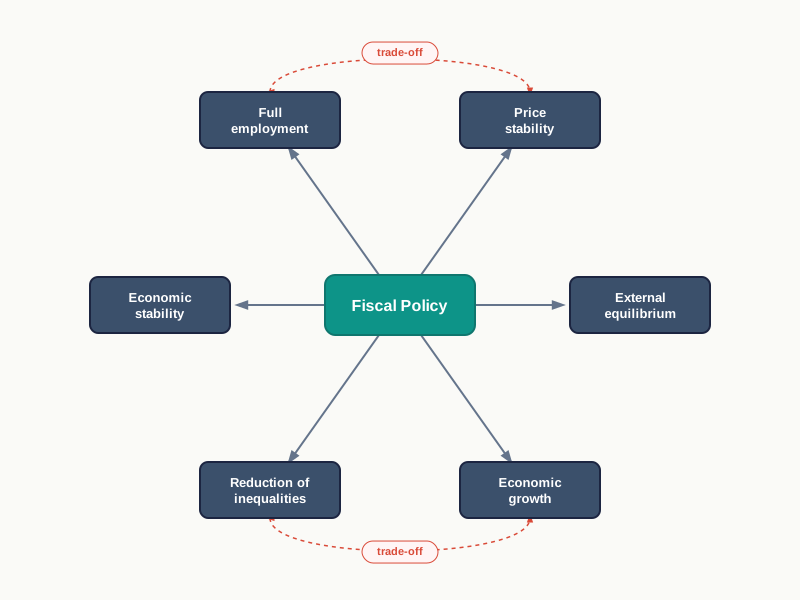
Fig. 16.2 – The objectives of fiscal policy.
16.2.3 The Three Instruments of Fiscal Policy
Fiscal policy has three instruments, and only three: taxation, public expenditure and public borrowing. The channels along which they reach the economy were shown in Fig. 16.0, and each is taken up in detail in the sections that follow.
- Taxation — the main source of the government’s revenue. Under this head economics studies the types of taxes, the principles on which they should be levied, the effects they produce and the way the burden is distributed among different classes in society.
- Public expenditure — the spending of public authorities. Under this head come the types of expenditure, the principles governing it and its effects on production, employment, the distribution of income and the rate of growth of different sectors.
- Public borrowing — the debt raised by the government. Under this head come the methods of raising loans from the public at home and abroad, their economic effects, and the methods by which the debt is repaid and managed.
The three cannot be handled separately. Expenditure fixed above revenue has to be met by borrowing or by the creation of new money, so a decision about any one instrument is also a decision about the other two. This is why fiscal policy is judged by the combination adopted and not by any single measure taken on its own.
16.3 Public Revenue and Taxation
Whatever a government decides to spend, it must first decide from whom to take. Nothing the state distributes has been produced by the state itself, so every rupee of public expenditure is a claim transferred from a private hand to a public one. The first instrument of fiscal policy is therefore the machinery by which that transfer is made, and the question it settles is not only how much shall be taken but from whom.
16.3.1 Public Revenue and Its Sources
The need for raising revenue arises from the necessity of incurring expenditure. A government does not collect money for its own sake; it collects because it has undertaken to maintain law and order, provide defence, run services and promote development, and these functions have to be financed year after year.
The government’s income comes from two broad sources.
- Tax revenue — the compulsory payments levied on income, wealth, production and expenditure. This is much the larger source in most economies, and the one over which the government has the widest control.
- Non-tax revenue — everything else the government earns: fees charged for services rendered, fines and penalties, interest on loans it has advanced, dividends and profits from public sector undertakings, and receipts from the sale of goods and services produced by the public sector.
Public revenue must be distinguished from public receipts, which are wider. Public receipts take in every rupee that reaches the treasury, and therefore include borrowings and the issue of new currency as well. The difference is that revenue is not repayable, while a loan is. Money raised by borrowing swells the receipts of the year in which it is taken but creates an obligation on the years that follow, so it cannot be treated as income.
16.3.2 Taxes: Meaning and Characteristics
A tax is not a price. A household that buys a service in the market pays for what it receives and may refuse to buy. A taxpayer can do neither. The payment is compulsory, and what is received in return is not a particular service but a share in the general benefits the government provides to everyone.
The nature of a tax can be set out in four characteristics.
- Compulsory contribution — a tax is levied by the authority of the state on income earned, property owned or economic activity carried on. Since it is compulsory, no one may refuse to pay, and refusal invites legal action and punishment.
- Personal obligation — the liability rests on the taxpayer personally. It is the taxpayer’s duty to pay what is due, to disclose income honestly and not to attempt evasion.
- General benefit — the money collected is not spent for the benefit of the individual taxpayer alone but for the common benefit of all. A person who pays property tax to the municipality cannot demand that the road in front of that particular house be repaired.
- No quid pro quo — nothing is promised in return. There is no direct give-and-take between the government and the taxpayer, and a person who pays a lakh of rupees in income tax cannot claim benefits of an equal amount.
16.3.3 Direct and Indirect Taxes
Taxes may be classified by their form, their nature, their aim or the method by which they are levied. The oldest and most useful classification divides them into direct and indirect taxes, and the basis of that division is the shifting of the ultimate burden.
Two terms are needed before the division can be stated. The impact of a tax is the burden of the tax on the person who pays it to the government in the first instance. The incidence of a tax is the money burden of the tax on the person who ultimately pays it. Where impact and incidence rest on the same person the tax is direct; where they fall on different persons it is indirect. The route by which the burden travels is shown in Fig. 16.3.
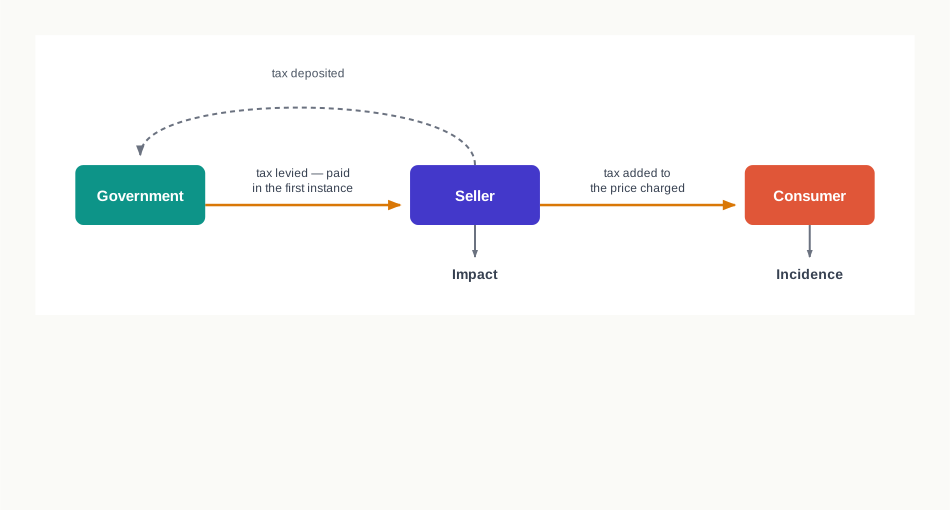
Fig. 16.3 – Impact and incidence of an indirect tax.
Income tax is the plainest example. The person on whom it is levied must pay it and cannot pass it on to a customer or a supplier. Corporation tax on a company’s profits and the tax on capital gains work in the same way.
Indirect taxes are collected from producers, sellers and importers, who recover them by raising the prices they charge. The goods and services tax and the customs duty on imports belong to this class.
The two classes may also be told apart by what is taxed rather than by who bears the burden. On this second basis a direct tax is one levied on the income and property of a person — income tax, corporation tax, capital gains tax — while an indirect tax is one levied on expenditure incurred, such as the goods and services tax or the duty on imports. The two bases usually give the same answer. The main points of difference are set out below.
Merits And Demerits Of Direct Taxes
- Economical — the cost of collection is low, because such taxes are usually collected at source and are paid to the government directly by the taxpayers themselves.
- Certain — the taxpayer knows how much is to be paid, on what basis and by when, and the government knows fairly closely what it will receive. The canon of certainty is satisfied on both sides.
- Equitable — the rate schedule can be made to conform to the principle of ability to pay. By making the structure progressive, a heavier burden is placed on the rich than on the poor, and the poorest sections can be exempted altogether.
- Elastic — revenue can be raised by increasing the rates in a time of crisis, and the yield rises of its own accord as the incomes of the people rise.
The drawbacks are equally clear.
- Unpopular — the taxpayer feels the pinch directly, because the payment cannot be shifted and is made in a visible lump.
- Scope for evasion — since the tax is assessed on income declared, people may conceal income and manipulate accounts to pay less, which generates unaccounted money and costs the government revenue.
- Adverse effect on the will to work and save — high rates of income tax may discourage extra effort, and by leaving less income in hand they reduce the ability to save, so capital formation suffers.
- Narrow base — direct taxes fall on a limited group of higher income earners and companies while the poorer sections are exempt, so only a small proportion of the population contributes.
Merits And Demerits Of Indirect Taxes
- Convenient — the tax is paid in small amounts as and when goods are bought, and is included in the price, so the burden is not felt sharply. It is convenient to collect as well, since it is gathered from a limited number of sellers, manufacturers and importers.
- Wide coverage — everyone who buys the taxed goods contributes, rich or poor, so the tax system is broad-based and even those outside the income tax net pay something towards the revenue.
- Less scope for evasion — the tax is part of the price of the commodity, so the buyer cannot avoid it, and with proper administration evasion by sellers can be contained.
- Useful in directing consumption — heavy duties on goods that are injurious to health restrain their consumption by raising their prices, while light rates on necessities keep them within reach.
The drawbacks are as follows.
- Regressive and unjust — the same rate is charged to rich and poor alike. Since the poor spend a larger part of their income on the taxed goods, the burden falls disproportionately on them and the principle of ability to pay is negated.
- Inflationary — an indirect tax raises the price of the commodity at once. A higher cost of living may bring demands for higher wages, and costs and prices can be pushed up further.
- Uneconomical — the tax has to be collected from a large number of sellers spread over the country, and production and sales must be watched, so the administrative cost of collection is heavy.
- Uncertain revenue — when the tax raises the price of a commodity contraction in demand occurs, and by how much it will fall cannot be known in advance. The yield of the tax is therefore difficult to estimate.
16.3.4 Proportional, Progressive, Regressive and Degressive Taxes
Taxes may also be classified by the degree of progression, that is, by the way the rate of tax behaves as the tax base changes. Taking income as the base, the question is what percentage of income is taken as income rises. On this footing a tax is proportional, progressive, regressive or degressive.
- Proportional taxation — the rate of taxation remains the same as the income of the taxpayer increases. All incomes are taxed at a single uniform rate, so the amount of tax rises with income while the proportion of income taken stays unchanged.
- Progressive taxation — the rate of taxation increases as the income of the taxpayer increases. A lower income is taxed at a lower rate and a higher income at a higher rate, so the tax rises both in absolute terms and as a proportion of income.
- Regressive taxation — the rate of taxation decreases as the income of the taxpayer increases. A larger income gives up a smaller percentage of itself, so the burden falls more heavily on the poor. Wholly regressive systems belong to history, but indirect taxes have a regressive effect.
- Degressive taxation — the rate of progression does not increase in the same proportion as the increase in income. The rate rises with income, but by less and less, and beyond a certain level a uniform rate is charged. A degressive tax is thus mildly progressive at first and proportional thereafter.
The behaviour of the four rate structures is compared in Table 16.1.
Read across the rows and the difference is plain. The proportional column does not move, the progressive column climbs with income, the regressive column falls, and the degressive column climbs at first and then stands still. The same information is shown as four lines in Fig. 16.4.
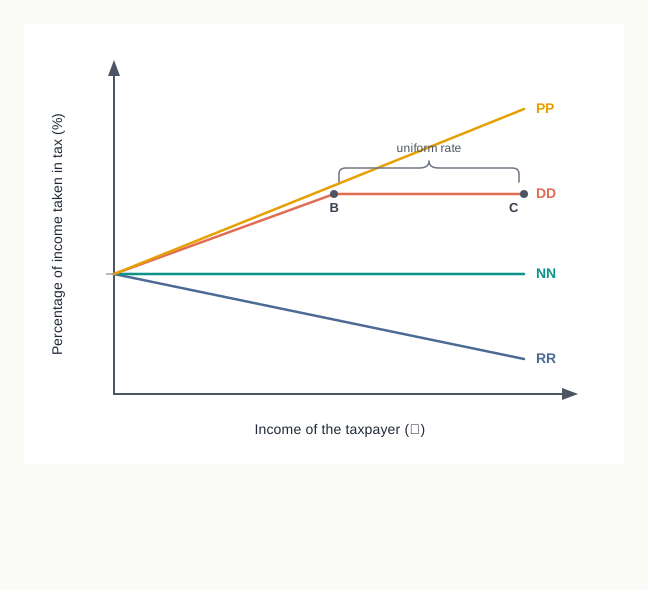
Fig. 16.4 – Proportional, progressive, regressive and degressive taxes.
Which structure is to be preferred depends on what is asked of the tax. Progressive taxation is the one generally accepted as desirable, because it distributes the burden according to ability to pay, reduces inequalities of income and wealth, yields more revenue as incomes rise, and costs no more to collect at a higher rate than at a lower one. Proportional taxation is simple and easy to understand, but it takes the same share from a poor taxpayer as from a rich one and so imposes the greater real sacrifice on the poor. Regressive and degressive structures are not approved on grounds of equity, since they place the heavier relative burden on those least able to bear it.
No single structure need be used for every tax. A good tax system holds direct and indirect taxes in proper balance, some of them progressive and some proportional, so that revenue is adequate, evasion is contained and the burden is distributed with reasonable justice. Where indirect taxes form a large share of the total, as they long have in India, the structure as a whole tends towards regression, since such taxes fall on everyone irrespective of the capacity to pay.
16.4 Public Expenditure
The revenue side of the budget answers the question of who gives up purchasing power. The expenditure side answers a harder one: what the community gets for it. A government that spends on a school is not spending on a road, and the choice between them is the ordinary problem of scarcity presented in a public form. The second instrument of fiscal policy is therefore the spending decision itself.
16.4.1 Meaning of Public Expenditure
Expenditure incurred by public authorities falls into two broad purposes. Some of it keeps the government itself in working order — administration, the maintenance of law and order, the courts. The rest meets wants that individuals cannot conveniently satisfy for themselves: education, public health, public works, transport, defence.
In a modern welfare state the second purpose has grown much the larger of the two. The government provides social security such as old-age pensions, builds the economic and social overheads on which private activity depends — transport, communication, power — undertakes welfare activities in education, medicine and housing, and spends directly on promoting economic development. Each of these is a claim on the same limited resources, which is why the composition of public expenditure matters as much as its size.
The Growth Of Public Expenditure
Over the last hundred years the functions of government have expanded remarkably in almost every country, and public expenditure has expanded with them. Writing in the late nineteenth century, the German economist Adolph Wagner observed the same tendency in his own country and in others, and stated it as a law.
The Indian experience supports the law. The size of public expenditure has increased manifold since the beginning of planning, and the ratio of public expenditure to gross domestic product in India is now among the highest in the developing world. The main factors behind the increase are large defence commitments, the growth and urbanisation of the population, the expansion of the administrative machinery, the developmental and welfare functions the state has taken on, the building of infrastructure, the servicing of public debt and the burden of subsidies.
16.4.2 Types of Public Expenditure
Public expenditure has been classified in several ways, and the classifications are not rivals: each looks at the same spending from a different angle. Three of them are in common use, and they are set out together in Fig. 16.5.
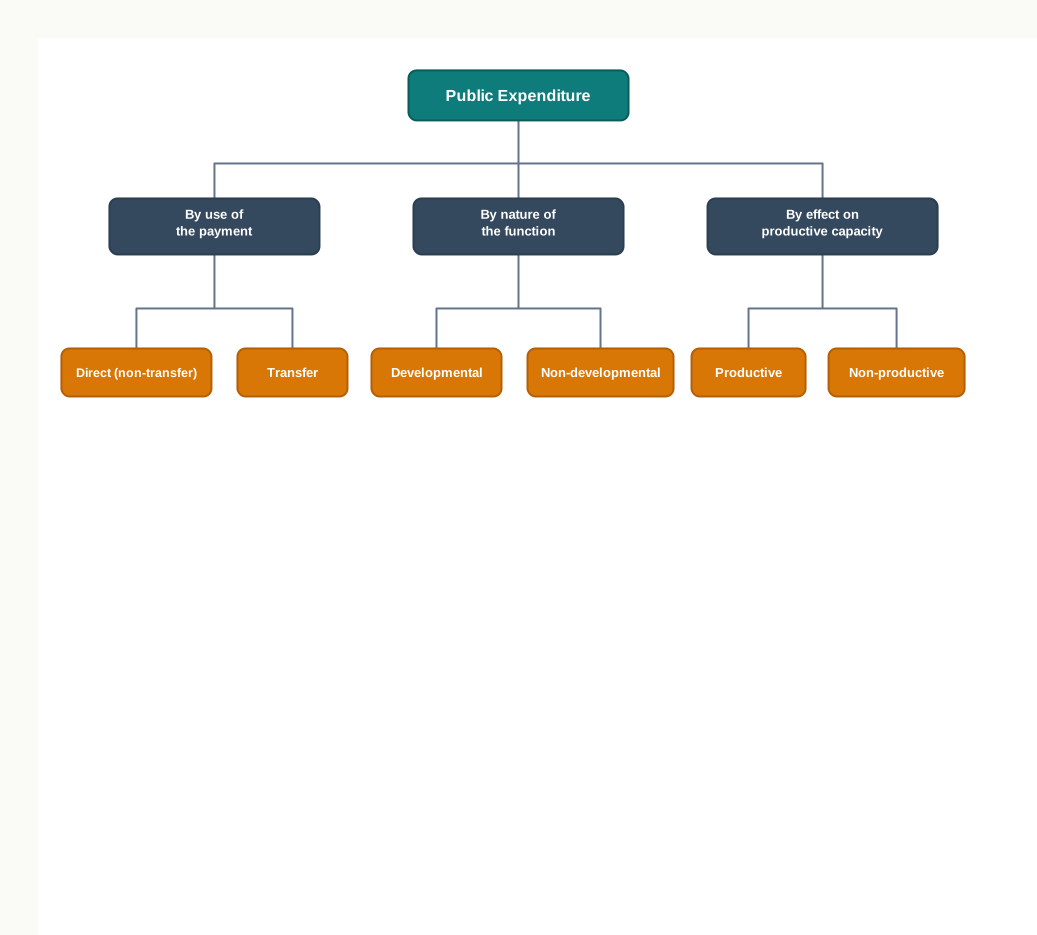
Fig. 16.5 – Classification of public expenditure.
Direct And Transfer Expenditure
Direct expenditure is expenditure incurred by the government on the purchase of goods and services and on the current services of factors of production. Spending on defence, on the civil services, on educational services, on the judiciary and on investment is of this kind. The government receives something in return, and the payment creates income in the current period, which is why direct expenditure is also called exhaustive or non-transfer expenditure.
Transfer expenditure takes the form of payments made without any corresponding return of goods or factor services to the government. Interest on public debt, old-age pensions, sickness benefits, unemployment allowances and subsidies belong here. Such payments do not generate current production; they move purchasing power from one section of the community to another.
Developmental And Non-Developmental Expenditure
Developmental expenditure is expenditure incurred on promoting the economic and social development of the country. It covers social and community services such as education, scientific services and public health, economic services such as transport and communication, grants-in-aid given to state governments for development purposes, and spending on agriculture and industry.
Non-developmental expenditure is expenditure incurred on the essential general services of the government. Police, defence, the administration of justice, general administration, interest payments, pensions and other retirement benefits fall under this head. The distinction is one of function, not of worth: an economy without courts or police would not develop at all.
Productive And Non-Productive Expenditure
Productive expenditure is expenditure that helps to improve the productive capacity of the economy. It is in the nature of investment, and may take the form of spending on physical assets such as machinery and factories or on human capital through education, training and health. Non-productive expenditure does not add to productive efficiency directly; it is in the nature of consumption, and covers administration, defence, justice and the maintenance of law and order.
16.4.3 Importance of Public Expenditure
Public expenditure is not merely a financial mechanism for meeting the government’s needs. Because it puts income into private hands, buys goods from private producers and builds the facilities on which private production depends, it exerts an influence on the whole economy. Its importance may be seen under five heads.
- Effect on production — public expenditure creates income for the individuals and firms from whom the government buys goods and factor services, and so raises their purchasing power. Spending on education, medical services, sanitation and housing raises the efficiency of the people at large; spending on training creates skills; and spending in the public sector on essential inputs such as steel and fertiliser removes shortages that would otherwise hold up production elsewhere.
- Effect on investment — expenditure on the maintenance of law and order creates confidence in the minds of investors. Expenditure on economic overheads such as power, irrigation, transport and communication makes private projects worth undertaking that would not otherwise pay, and financial assistance and subsidies to the private sector stimulate investment directly.
- Effect on the distribution of income — expenditure can be so devised as to benefit the poorer sections. Free education, free medical facilities, old-age pensions, unemployment relief and subsidies on articles of common consumption raise the real income of those who receive them, and expenditure directed at backward regions reduces regional disparities in the same way.
- Effect on economic growth — expenditure promotes growth directly by building infrastructure and establishing basic and key industries, and indirectly by providing education, training and research facilities that raise the efficiency and skill of the people. Growth achieved in this way is growth with social justice, since the same spending reduces disparities while it raises output.
- Effect on economic stability — public expenditure can be used as a compensatory device, making up for the deficiency of private aggregate demand in a depression and being curbed when private demand is excessive in a boom. Used this way it acts as a balancing factor that steadies income, output and employment.
The first of these effects works with a force greater than the sum spent, because the income the government pays out is spent again by those who receive it. The path it takes is shown in Fig. 16.6.
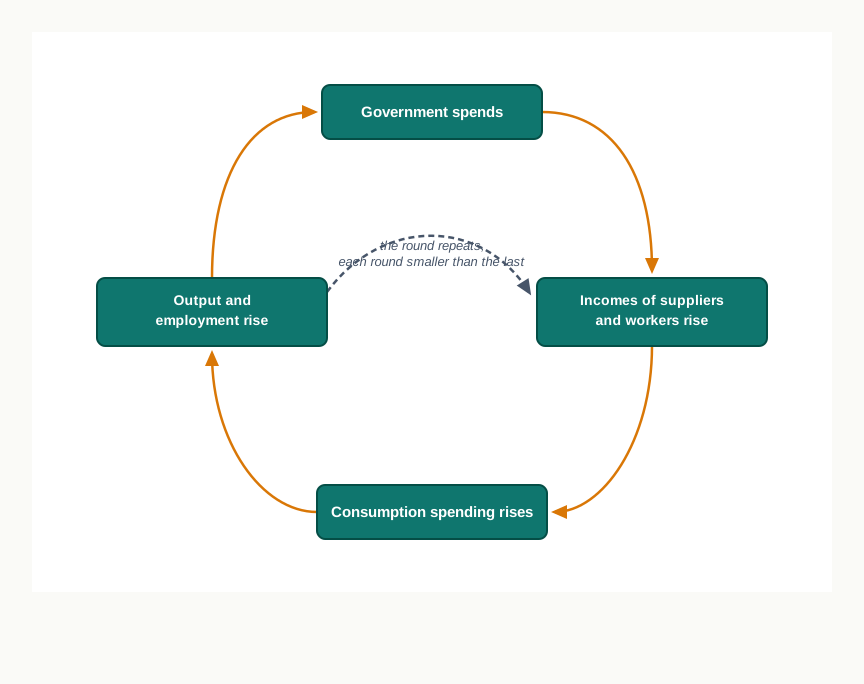
Fig. 16.6 – The multiplier effect of public expenditure.
16.5 Public Debt
Taxes have a limit. The taxable capacity of a people is fixed by their income, and a government that pushes rates beyond what that income will bear collects resentment rather than revenue. Yet the expenditure a modern state has undertaken cannot wait upon what the tax system happens to yield in a given year. The gap is bridged by borrowing, and borrowing is the third instrument of fiscal policy.
16.5.1 Meaning and Types of Public Debt
Borrowing by the government has become a normal method of public finance, standing alongside taxes and fees rather than being reserved for emergencies. The loans so raised, taken together with the interest owed on them, make up the public debt.
The lenders are of many kinds. Within the country the government borrows from individuals, business enterprises and banks, by selling government bonds and treasury bills, by taking small savings and provident fund balances and by borrowing from the central bank. Outside it, the government borrows from the governments of other countries and from international financial institutions.
Internal And External Debt
Internal debt refers to the public loans floated within the country, the government borrowing from individuals and institutions located inside it. The payment of interest on internal debt does not pose much of a problem, because it only redistributes income within the country: what is collected in taxes from one set of citizens is paid out as interest to another.
External debt refers to loans taken from individuals, institutions and governments of foreign countries and from the international financial institutions. Interest and repayment here have to be made in foreign currency, so a part of the country’s income and wealth is transferred abroad, and foreign exchange earned by exports is used up in servicing the debt instead of paying for imports the country needs. The difference is drawn in Fig. 16.7.
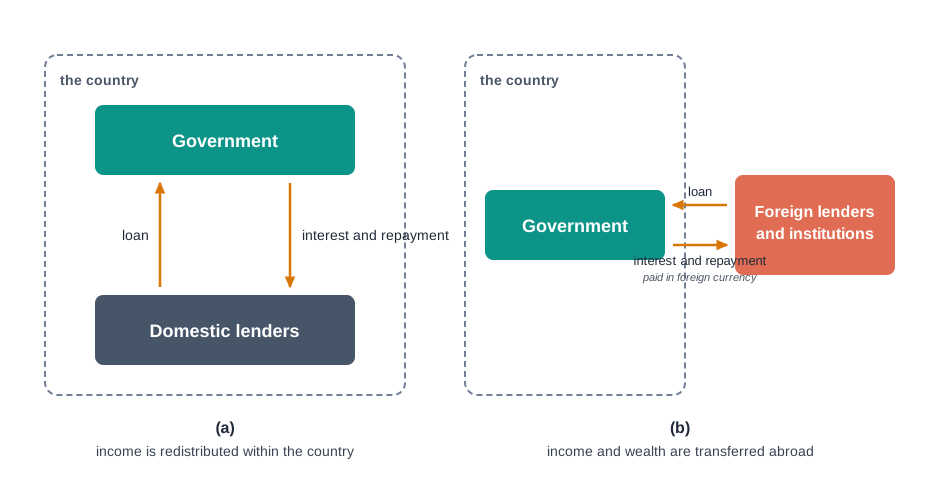
Fig. 16.7 – Internal and external debt.
Productive And Unproductive Debt
Productive debt is debt used by the government for directly productive purposes — the development of railways, power projects, irrigation works and the establishment of industries. It adds to the productive capacity of the economy and can be repaid out of the revenues the projects themselves generate, so it constitutes no lasting burden on the taxpayer.
Unproductive debt is debt incurred for undertakings that are not directly productive, such as financing a war or meeting the cost of a flood or an epidemic. It adds nothing to productive capacity, no income arises from which to repay it, and the whole burden falls on the taxpayer. Debt of this kind is known as deadweight debt.
Short-Term And Long-Term Debt
Short-term debt is debt raised for a short period, usually of three to nine months. Treasury bills and advances from the central bank are the common instruments, and the rate of interest on them is generally low. Long-term debt is repayable after a long period, say five years or more, is raised largely for development purposes and carries a higher rate of interest, since the lender parts with the money for longer. Public debt is also classified as funded and unfunded, voluntary and compulsory, redeemable and irredeemable, and marketable and non-marketable.
16.5.2 Reasons for Borrowing by the Government
A government does not borrow for a single reason, and the reasons differ with the situation it faces.
- To meet a budgetary deficit — the revenue of the year may fall short of the expenditure of the year, and short-period loans are then needed to cover the gap between the two.
- To finance a war — modern warfare is enormously expensive and cannot be financed by taxation alone. Much of the increase in public debt in the developed countries during the twentieth century arose from the two World Wars.
- To finance development plans — a developing country must undertake large developmental projects, and cannot resort to heavy taxation because the taxable capacity of its people is low. Public loans are the only way out, and India’s plan expenditure was financed substantially in this manner.
- To obtain foreign exchange — capital equipment and raw materials have to be bought from abroad during the early stages of development, and the balance of payments deficit that follows has to be covered. Resources for this can be obtained only by borrowing abroad.
- To check a recession — when private consumption and investment fall, the government can raise loans and spend the proceeds, so that aggregate demand is restored before the recession deepens into a depression.
- To meet unforeseen expenses — floods, famines, earthquakes and epidemics call for heavy expenditure at short notice, and the money has to be found at once rather than in the next budget.
- To finance public enterprises — where the public sector is expected to build basic and heavy industries and create infrastructure, the funds required are far beyond what taxation can provide.
- As a soft revenue option — a large increase in taxes is resented everywhere, while a loan is given voluntarily and provokes no opposition. Governments therefore find borrowing the easier course, which is precisely why it needs to be watched.
16.5.3 Redemption of Public Debt
Debt that is raised must eventually be discharged. A government that fails to repay finds its credit shaken and may be unable to raise loans when it next needs them, so the manner of repayment is as much a part of fiscal policy as the manner of borrowing.
The methods in use are the following.
- Repudiation of debt — the government refuses to pay the interest and the principal. It is not repayment at all but a rejection of the obligation, and it shakes public confidence so severely that it is resorted to only in extreme circumstances.
- Refunding — the government issues fresh bonds to pay off the bonds falling due, taking a new loan to repay an old one. The money burden is postponed rather than liquidated, and the total burden of debt continues to accumulate.
- Debt conversion — an old high-interest loan is exchanged for a new low-interest one. The loan is not repaid and the form of the debt alone changes, but the interest burden falls. This is possible only when the market rate of interest has fallen and the government enjoys good credit.
- Budgetary surplus — the government uses a surplus in its budget to buy back its own bonds and securities from the market, so that the debt is liquidated automatically. Surplus budgets, however, are rare.
- Terminal annuities — the debt is paid off in equal annual instalments that include both interest and a part of the principal. The burden diminishes year by year and the debt is fully discharged by the date of maturity.
- Sinking fund — the government establishes a separate fund and credits a certain amount of revenue to it every year, so that the accumulated sum is available for repayment when the loans fall due. It is regarded as the most systematic method of redemption.
- Statutory reduction in the rate of interest — the government reduces by law the rate of interest payable on its debt, and the creditors have to accept the reduced rate. This is done only in a period of severe financial crisis.
- Capital levy — a very heavy, once-for-all tax is imposed on property and wealth above a certain value, on a progressive scale, and the proceeds are used to clear the debt. It is a quick and equitable method, but it suits abnormal situations such as the aftermath of a war rather than normal times.
- Export surplus — external debt has to be repaid in foreign exchange, which can be earned only by exporting more than the country imports. If the foreign loans were invested in industries producing exportable goods, the surplus arises from the loan itself; if they were not, exports have to be increased by reducing the goods available at home.
16.6 Deficit Financing
Taxes have a ceiling and loans have to be repaid. When a government has exhausted what it can raise by either route and still faces expenditure it is unwilling to abandon, one course remains: it can create the money it needs. This is the least visible of the ways of paying for public expenditure, and for that reason the one that has to be watched most closely.
16.6.1 Meaning of Deficit Financing
Deficit financing is not the same thing as spending more than one earns. Every government that runs a deficit budget spends more than its revenue, and most of them cover the gap by borrowing. Deficit financing describes what happens when the gap is met not by taking purchasing power from someone else but by adding new money to the economy.
The term is used in two senses. In the western countries, the excess of government expenditure over its current revenue from taxes and non-tax sources is called deficit financing, and the deficit is normally covered by market borrowings and sometimes by the creation of new money. In India the term is used more narrowly, to denote the excess of total government expenditure over total revenue including public borrowings. On the Indian usage, therefore, a deficit remains only after borrowing from the public has been exhausted, and it can be met in one of two ways.
The two Indian routes come to the same thing. When the government runs down the cash balances it holds with the Reserve Bank of India, those balances are withdrawn from the central bank and released into circulation. When it borrows from the Reserve Bank, the loan is given by issuing fresh currency. In both cases the supply of money in the economy increases, which is why the practice is described as the monetisation of the deficit. The sequence is set out in Fig. 16.8.
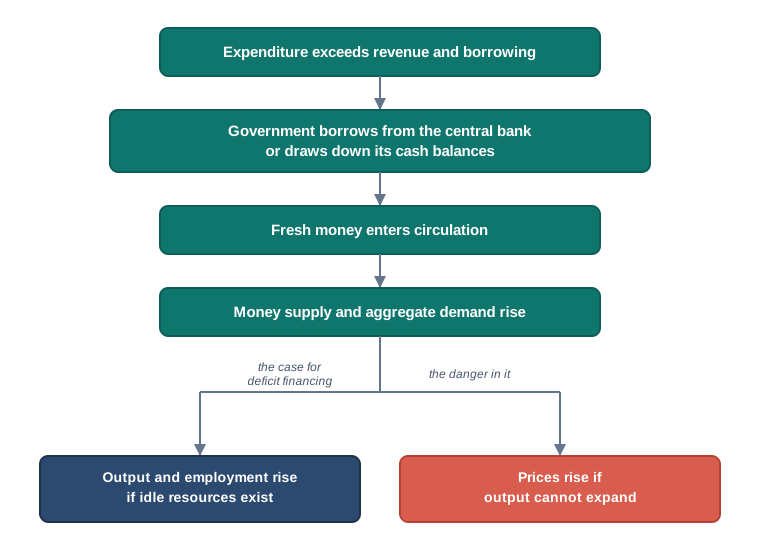
Fig. 16.8 – The mechanism of deficit financing.
Why Deficit Financing Is Used
Deficit financing has been resorted to in three broad situations. In war, resources have to be mobilised faster than any normal method of raising revenue allows. In a depression, for the reason set out in 16.2.1, private spending is deficient and the government must spend more than it takes away if output and employment are to recover. In a developing economy it has been recommended as a way of financing development plans, and the arguments used are these.
- Raising additional resources — taxation is limited by the low taxable capacity of a poor population, and voluntary borrowing is limited by low savings. New money can be created quickly when neither will yield enough.
- Generation of forced saving — deficit financing raises prices, real consumption falls because the same money income now buys less, and the resources released pass into the hands of the government and of producers. Saving brought about in this way is called forced saving, and it arouses none of the opposition that a tax would.
- Increase in aggregate demand — the money spent raises the incomes and purchasing power of the people, and the increased demand for goods and services leads to increased production and employment where resources lie idle.
- Meeting the demand for money — a growing economy that is steadily becoming more monetised needs a larger quantity of money to carry on its transactions, so a part of the money injected serves a genuine purpose beyond financing the deficit.
16.6.2 Effects of Deficit Financing
Whether the new money raises output or only prices depends on one condition: whether unused resources are available. Where labour and capacity lie idle, the additional demand calls forth additional production. Where they do not, the additional demand meets an unchanged supply of goods, and the effects turn adverse.
- Inflationary rise in prices — the extra purchasing power in the hands of the people raises the demand for goods and services. If aggregate supply does not increase correspondingly in the short run, prices rise, rising prices raise costs, and a cost-price spiral may set in.
- Unequal impact of forced saving — the burden of the price rise falls most heavily on those whose money incomes are fixed, such as wage and salary earners, since their real income shrinks while others’ incomes rise with prices.
- Unequal distribution of income — profits tend to rise during inflation while the purchasing power of fixed income groups falls, so income and wealth are redistributed in favour of producers and traders and inequality widens.
- Change in the pattern of investment — when prices are rising, hoarding and speculation become the most profitable activities, and investment is drawn away from machinery and equipment towards holding goods. The composition of investment is distorted just when a developing economy most needs productive investment.
Deficit financing is therefore an important device for financing development in a poor economy, and a dangerous one if it is not kept within limits. Used in moderation, and alongside measures that hold prices and costs in check, it puts idle resources to work. Used freely, it produces the inflation, the distorted investment and the arbitrary redistribution of income that were meant to be avoided.
16.7 Fiscal Policy in Action
The three instruments have now been examined one at a time. What remains is to see them used together and in a chosen direction, because a tax rate or a spending programme has no fiscal meaning by itself. What matters is which way the whole set is pointed, and against which problem.
16.7.1 Fiscal Policy and Inflation
Inflation of the demand-pull kind arises when the community’s spending runs ahead of the goods available to be bought. Too much money is chasing too few goods, and prices rise until the two are brought back into line. The fiscal remedy follows directly from the diagnosis: if demand is excessive, demand must be reduced.
The policy works through all three instruments.
- Taxation — the major plank. Tax rates are raised and new taxes imposed, so that less purchasing power is left in private hands. Direct taxes such as income tax and corporation tax are the suitable ones, since they cut the disposable income of the taxpayer and thereby the expenditure that would have flowed from it. The structure should at the same time be framed so as to encourage saving and productive investment rather than merely to punish income.
- Public expenditure — since government spending is itself a component of aggregate demand, reducing it reduces the demand directly. Much public expenditure is of an essential nature and cannot be cut, so what has to be curtailed is unproductive and non-essential spending.
- Public borrowing — borrowing from the public transfers purchasing power from the people to the government and reduces the need for deficit financing. The effect is not certain, however: if people subscribe out of savings they had no intention of spending, rather than by curtailing their consumption, total demand may not fall at all.
Taken together, a decrease in government expenditure and an increase in government revenue produce a surplus budget, and it is the surplus, not any single measure, that withdraws demand from the economy.
16.7.2 Fiscal Policy, Stability, Growth and Equity
The opposite problem calls for the opposite treatment. In a depression the level of income is low, unemployment is heavy and the cause is a deficiency of aggregate demand, so the government must put demand back into the economy instead of taking it out.
Four measures are used. The government adopts a deficit budget in which expenditure exceeds revenue, the deficit being met by borrowing or by deficit financing. Taxes are reduced, so that more purchasing power is left with individuals and consumption expenditure rises. Public expenditure is increased, particularly on public works and on social security such as pensions and unemployment benefits. And the funds borrowed are taken from those with whom money is lying idle, so that spending is created rather than merely transferred.
Set side by side, the two directions of policy are mirror images of each other.
Because the two directions answer to the two phases of the business cycle, the policy as a whole is described as counter-cyclical fiscal policy: taxes and government spending are varied in an anti-cycle direction, spending being cut and taxes raised in the expansionary phase of the cycle, and spending raised and taxes cut in the contraction. The pattern is shown in Fig. 16.9.
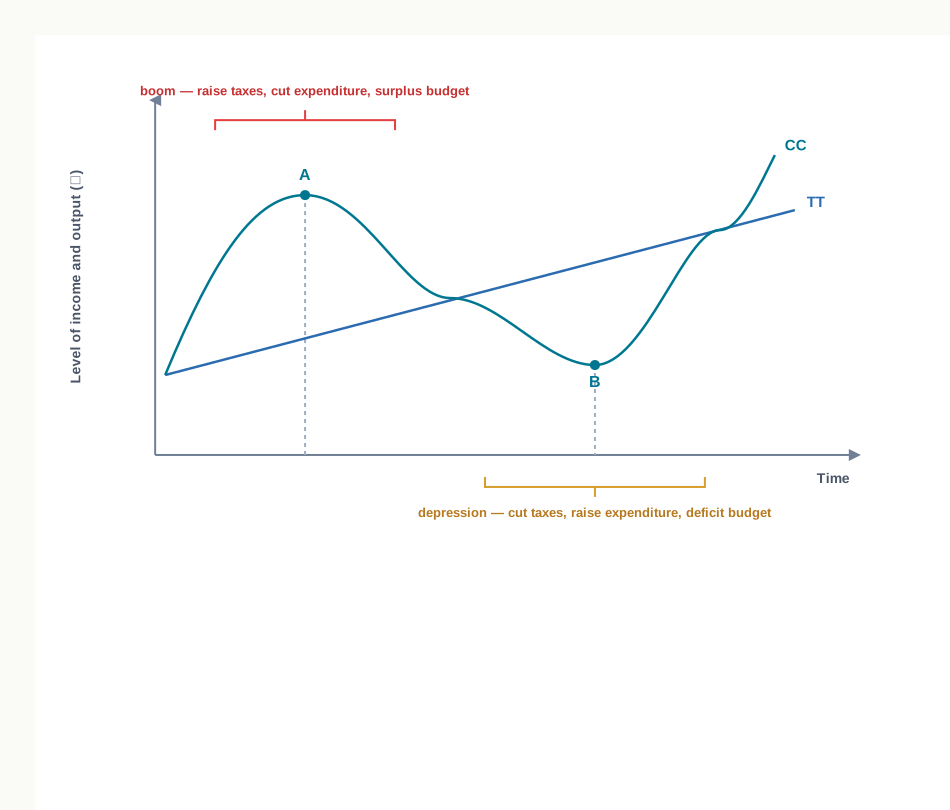
Fig. 16.9 – Counter-cyclical fiscal policy.
Fiscal Policy And Economic Growth
In a developing economy the problem is not the swing of the cycle but the level around which it swings. Fiscal policy is used here to raise the rate at which real national income grows, and the following steps serve that end.
- Incentives to save and invest — taxation and borrowing policies are so framed that saving is rewarded rather than penalised, since domestic saving is what finances investment.
- Tax relief and subsidies to producers — relief granted to entrepreneurs who invest raises the return on new projects and so raises the level of economic activity.
- Concessions for backward regions — special incentives such as a tax holiday, together with subsidies, draw industry to regions that private investment would otherwise pass by.
- Public investment in the base of the economy — revenue collected is used to build transport, communication, power and irrigation, and to establish capital goods and basic industries, on which private production depends.
- Expenditure on human capital — education, training and research facilities raise the efficiency of the workforce, and the returns from this expenditure accrue over whole working life of those educated.
Fiscal Policy And Equity
Growth with equity is the declared objective of economic policy in the developing countries, and equity here means making the distribution of income less unequal than the market by itself would leave it. Fiscal policy works on both sides of the account.
- Progressive direct taxation — the rate rises with income, so the rich contribute a larger share of a larger income, and the very poor are exempted from direct taxes altogether.
- Selective indirect taxation — luxuries consumed by the well-off are taxed heavily, while the daily necessities on which the poor spend the bulk of their income are taxed lightly or not at all.
- Expenditure directed at low incomes — social services such as education and public health are provided free or at subsidised prices, which raises the real income of the poor and their earning capacity together.
- Social security — pensions, unemployment relief and sickness benefits protect those with no income of their own, and are financed from the revenue of those who have.
- Reduction of regional disparities — investment in industry in the backward regions, aided by tax concessions, raises incomes where they are lowest instead of adding to them where they are already high.
These four uses of fiscal policy — against inflation, for stability, for growth and for equity — draw on the same three instruments, and they do not always pull in the same direction. Heavy progressive taxation serves equity but may weaken the incentive to invest on which growth depends; expenditure raised to secure full employment may disturb the price stability just achieved. Choosing the proportions in which the instruments are used is therefore the whole of the art, and the trade-off described in 16.2.2 is never far away.
16.8 Summary
- Public finance is the study of the income and expenditure of public authorities, and of the adjustment of the one to the other.
- Public authorities include every tier of government — local bodies such as municipal and district boards, state governments and the central government.
- Public finance is studied under four heads:
- public revenue, or where the money comes from;
- public expenditure, or where it goes;
- public debt, or what is done when revenue falls short;
- fiscal policy, or the deliberate use of the first three.
- Fiscal policy is the policy under which the government uses the instruments of taxation, public spending and public borrowing to achieve the objectives of economic policy. Its significance as an instrument of economic policy was first emphasised by Keynes in the mid-1930s.
- The objectives of fiscal policy are economic stability, full employment, economic growth, price stability, reduction of inequalities in income and wealth, and external equilibrium. Stability and full employment are stressed in developed economies, growth and the reduction of inequality in developing ones.
- Full employment means that all those willing to work at the existing wage rate are able to get work. It does not mean zero unemployment, since frictional unemployment always remains.
- The objectives are not complementary. Pursuing one may mean moving away from another, so a government has to accept a trade-off among them.
- Fiscal policy has three instruments: taxation, public expenditure and public borrowing. A decision about any one of them is also a decision about the other two.
- Public revenue is the income of the government from all its sources, tax and non-tax. It differs from public receipts, which also include borrowings and the issue of new currency, because revenue is not repayable and a loan is.
- A tax is a compulsory payment made to the government to meet expenditure incurred in the common interest, without any direct return to the taxpayer. Its characteristics are that it is a compulsory contribution, a personal obligation, spent for the general benefit, and carries no quid pro quo.
- The impact of a tax is the burden on the person who pays it in the first instance; the incidence is the burden on the person who ultimately pays it.
- Taxes are classified on the basis of the shifting of the burden:
- a direct tax is one whose impact and incidence fall on the same person, such as income tax or corporation tax;
- an indirect tax is one whose impact and incidence fall on different persons, such as the goods and services tax or customs duty.
- Direct taxes are economical, certain, equitable and elastic, but unpopular, open to evasion, discouraging to work and saving, and narrow in base.
- Indirect taxes are convenient, wide in coverage, difficult to evade and useful in directing consumption, but regressive, inflationary, costly to collect and uncertain in yield.
- Taxes are classified on the basis of the rate structure:
- proportional, where the rate stays the same as income rises;
- progressive, where the rate rises with income;
- regressive, where the rate falls as income rises;
- degressive, where the rate rises with income but less than proportionately, and becomes uniform beyond a point.
- Progressive taxation is generally accepted as desirable, since it follows the principle of ability to pay, reduces inequalities, is elastic and is economical to collect. A good tax system nevertheless balances direct and indirect taxes, some progressive and some proportional.
- Public expenditure refers to the expenses incurred by public authorities for their own maintenance, for meeting the collective needs of citizens and for promoting economic and social welfare. Wagner’s law states that as an economy develops, the functions of the government increase and public expenditure rises with them.
- Public expenditure is classified in three ways:
- direct or non-transfer expenditure, which buys goods and factor services, and transfer expenditure, which is paid without any return;
- developmental expenditure, which promotes economic and social development, and non-developmental expenditure, which maintains the essential general services;
- productive expenditure, which adds to productive capacity, and non-productive expenditure, which does not add to it directly.
- Public expenditure is important for its effects on production, on investment, on the distribution of income, on economic growth and on economic stability.
- Public debt is the debt the government owes to its own subjects or to the nationals of other countries. It is classified as internal and external, productive and unproductive, and short-term and long-term.
- Governments borrow to meet a budgetary deficit, to finance a war, to finance development plans, to obtain foreign exchange, to check a recession, to meet unforeseen expenses, to finance public enterprises, and because a loan is a softer option than a tax.
- Redemption means the repayment of public debt. The methods are repudiation, refunding, debt conversion, budgetary surplus, terminal annuities, a sinking fund, statutory reduction in the rate of interest, capital levy and export surplus.
- Deficit financing means meeting the deficit between government expenditure and revenue through the creation of new money. In the Indian sense the deficit is what remains after public borrowing as well, and it is met by borrowing from the Reserve Bank or by drawing down cash balances, both of which raise the money supply.
- Deficit financing is used to meet war expenditure, to overcome a depression and to finance development plans. Its adverse effects are an inflationary rise in prices, an unequal burden of forced saving, an unequal distribution of income and a distorted pattern of investment.
- Contractionary fiscal policy — expenditure reduced, taxes and borrowing raised, aiming at a surplus budget — is used to control demand-pull inflation.
- Expansionary fiscal policy — expenditure raised and taxes reduced, aiming at a deficit budget — is used to overcome depression and unemployment. Varying the two with the phases of the cycle is called counter-cyclical fiscal policy.
- Fiscal policy promotes growth through incentives to save and invest, concessions for backward regions and public investment in infrastructure and human capital. It promotes equity through progressive direct taxes, heavier taxes on luxuries, expenditure on social services for low-income groups and the development of backward regions.
16.9 Points to Ponder
- Deficit financing raises resources by raising prices, and the resources released come chiefly from those whose money incomes are fixed. Is a burden that nobody voted for and nobody can see fairer, or less fair, than a tax openly imposed?
- Progressive taxation is defended on the ground that it takes more from those who can spare more, and attacked on the ground that it takes most from those who add most to output. If a country had to choose between the tax system that raises the largest revenue and the one that distributes the burden most equally, which should it prefer?
- Indirect taxes are called regressive, yet they reach the whole population while direct taxes reach only a small part of it. In a country where few earn enough to be liable to income tax, can a tax system be broad-based and equitable at the same time?
- Internal debt is often said to be no real burden, because the country owes the money to itself. Does the argument still hold when the taxpayers who service the debt and the bondholders who receive the interest are different people?
- A road and a pension are both public expenditure, but one adds to output while the other only moves purchasing power from one hand to another. Should a government judge the two by the same test, and what would be lost if it did?
- Counter-cyclical policy asks a government to cut its spending and raise taxes exactly when a boom has made revenue plentiful and spending popular. Is a policy that demands this of politicians workable in practice, and what arrangements might make it more so?
16.10 Objective Questions
- Which of the following is not an instrument of fiscal policy? [1]
- Taxation
- Public expenditure
- Public borrowing
- Bank rate
- The impact and the incidence of a tax fall on different persons in the case of: [1]
- a direct tax
- an indirect tax
- a progressive tax
- a capital levy
- A tax whose rate rises as income rises, but less than proportionately, and becomes uniform beyond a certain level of income, is called a ______ tax. [1]
- Match each method of debt redemption in Column I with its description in Column II. [1]
| Column I | Column II |
|---|---|
| a. Refunding | i. A separate fund to which revenue is credited every year for the repayment of debt |
| b. Sinking fund | ii. A heavy once-for-all tax on property and wealth above a certain value |
| c. Capital levy | iii. Fresh bonds issued to pay off the bonds falling due |
- Assertion (A): Indirect taxes are regressive in their effect. Reason (R): The same rate is charged to the rich and the poor alike, and the poor spend a larger part of their income on the taxed goods. [1]
- Both (A) and (R) are true, and (R) is the correct explanation of (A).
- Both (A) and (R) are true, but (R) is not the correct explanation of (A).
- is true, but (R) is false.
- is false, but (R) is true.
16.11 Check Your Concepts
- Distinguish between the impact and the incidence of a tax. [2]
- Distinguish between developmental and non-developmental expenditure, giving one example of each. [3]
- Explain any two methods by which a government may redeem its public debt, and state one limitation of each. [4]
- An economy is passing through a period of demand-pull inflation. Explain how the government can use taxation, public expenditure and public borrowing to bring it under control, and state the kind of budget such a policy aims at. [6]
16.12 Case-Based Question
- Ravi Deshmukh runs a bakery in a small town. Prices in the state have been rising sharply, and the state government responds by raising the rate of tax on packaged food and by postponing the public works it had planned for the coming year. Ravi finds that the higher tax on each packet he sells is added to the price printed on the label, and that the new road which would have brought customers past his shop has been deferred.
- Identify the type of tax levied on the packets sold in Ravi’s bakery and state who finally bears its burden. Give a reason for your answer. [2]
- Name the kind of fiscal policy the state government is following and explain how the two measures described act on aggregate demand. [2]