Each year on 1 February the Union Finance Minister rises in the Lok Sabha to present the coming year’s budget. The speech runs to a long list of numbers, but underneath it lies a single economic problem. A government’s means are limited, while the claims on it — defence, roads, schools, hospitals, pensions, interest on past loans — are not. Every rupee committed to one head is a rupee that cannot be committed to another, so the government, like any household or firm, must choose. The budget is the document in which that choice is made and recorded. It sets out what the government expects to receive during the year and what it proposes to spend, head by head, and it separates the routine running of the state from the building of assets that will outlast the year. Where the proposed spending exceeds the expected receipts, the gap must be borrowed, and the size of that gap is itself a measure worth reading carefully. This chapter explains the meaning, objectives, types and components of the government budget, and the three measures of budget deficit used in India.
17.1 Meaning of a Government Budget
A government is expected to defend the country’s borders, maintain law and order, build roads and railway lines, run schools and hospitals, pay pensions and meet the interest on debt it has taken in the past. Every one of these activities costs money, and the money has to be raised — from taxes, from charges for the services the government provides, or from borrowing.
The sums that can be raised in a year, however, are limited, while the claims on them are not. A government therefore faces the same problem of scarcity and choice that a household or a firm faces, and it must settle before the year begins how much it expects to receive and how that amount is to be divided among competing heads of spending.
The document in which this decision is set down is the government budget. It is at once a financial plan and a statement of policy, because the heads given more money reveal what the government has chosen to treat as urgent and the heads given less reveal what it has chosen to postpone.
17.1.1 The Budget as an Annual Financial Statement
A budget has two sides. On one side it estimates what the government expects to receive during the coming year under each source of revenue; on the other it proposes what it intends to spend under each head of expenditure. Neither side records the past. Both are figures for a year that has not yet begun.
Government Budget A government budget is an annual financial statement showing the estimated receipts and the proposed expenditure of the government under various heads for the financial year, which in India runs from 1 April to 31 March.
In India the budget is not merely an administrative convenience but a constitutional obligation. Article 112 of the Constitution requires that a statement of the estimated receipts and expenditure of the Government of India for every financial year be laid before Parliament. This statement is the Annual Financial Statement, and it is what is popularly called the budget. Until Parliament has approved it, the government may not draw a rupee from the public purse.
Because the figures are forecasts, they rest on judgements that may prove wrong — on how fast output and prices will rise, on how much a given rate of tax will actually collect, on how quickly a project will absorb the money set aside for it. This is why the budget is presented as an estimate to be revised rather than an account to be settled.
A definition of the budget earns the mark only if it carries three things — that it is annual, that the figures are estimates, and that it relates to the financial year. Dropping ‘estimated’ is the common slip.
Features Of A Government Budget
The main features of a government budget are as follows.
- Annual statement — the budget is prepared for one financial year at a time, and a fresh budget must be placed before the legislature every year.
- Statement of estimates — the receipts are estimated and the expenditures proposed, so the figures are forecasts and not accounts of money already received or spent.
- Two sides — every budget sets receipts against expenditure, so that the two can be compared and the gap between them measured.
- Approval of the legislature — the budget has no force until it is passed, which is what makes it an instrument of control over the executive.
- Statement of policy — behind the figures lie the government’s decisions on taxing, borrowing and spending, so the budget is the fiscal policy of the year set out in numbers.
The budget states what the government expects to receive and proposes to spend. It is not a record of what was actually received and spent during the year.
17.1.2 The Fiscal Year and the Budget Estimates
The year to which a budget relates is the fiscal year, also called the financial year. In India it runs from 1 April to 31 March, so the budget for 2025–26 covers the twelve months from 1 April 2025 to 31 March 2026. Since the budget must be approved before the year it governs begins, it is prepared and presented in the closing weeks of the year before.
A budget document, however, does not carry one year’s figures alone. Three sets of figures are set side by side.
- Budget estimates — the estimated receipts and proposed expenditure for the coming year. This is what the budget is chiefly about.
- Revised estimates — the corrected figures for the year now running, prepared in the light of how receipts and spending have actually moved during its first eight or nine months.
- Actuals — the audited accounts of the last year for which the books have been closed, showing what was in fact received and spent.
The relation between the three is easiest to see on a time line, as in Fig. 17.1.
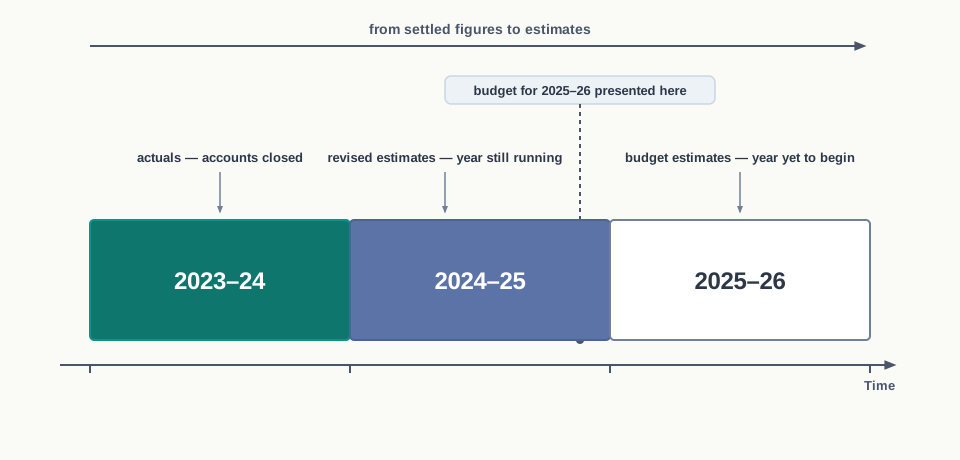
Setting the three columns together turns the budget into a document that can be judged rather than merely read. The reader can see how far the previous year’s estimates were met, whether a head of expenditure is being revised upwards year after year, and whether the government’s forecasts of its own revenue have been realistic.
Three Years In One Budget Document The Union Budget for 2025–26 does not deal with one year alone. It carries the budget estimates for 2025–26, the revised estimates for 2024–25, which was still running when the document was prepared, and the actual accounts for 2023–24, the last year whose books had been closed. Placing the three sets of figures side by side shows how far the earlier estimates were met.
17.2 Objectives of a Government Budget
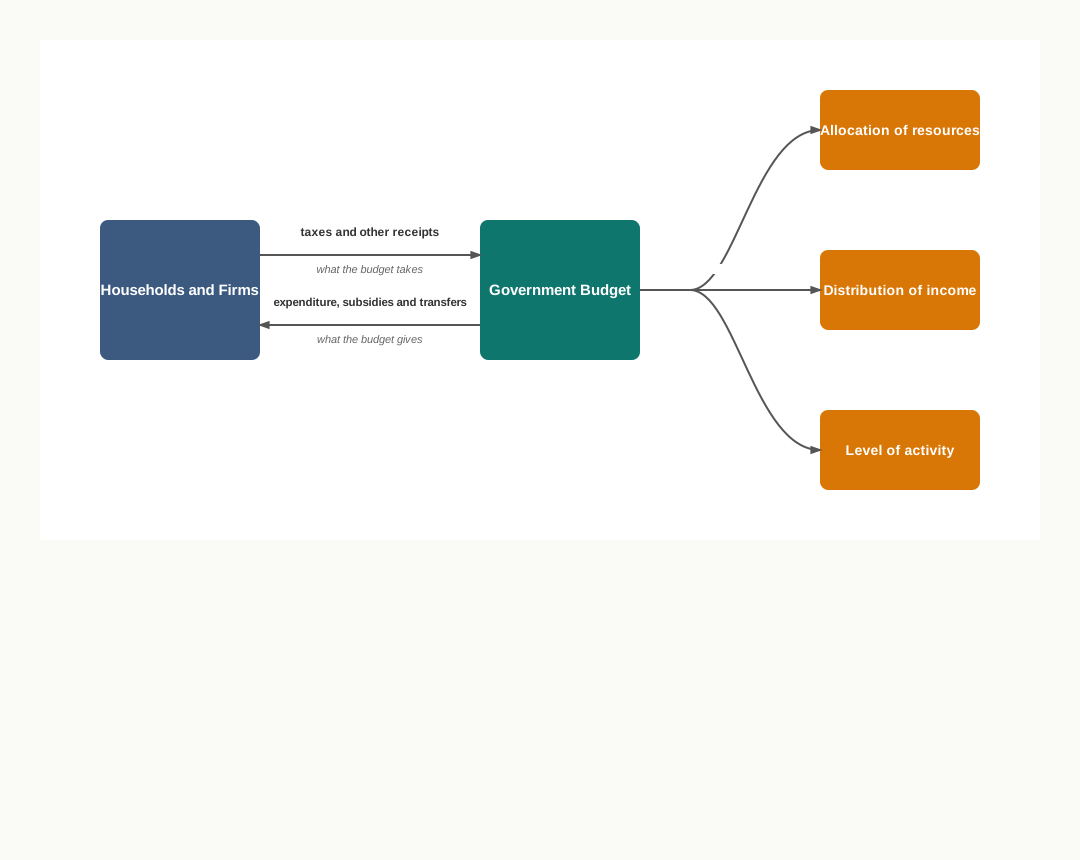
A government that collects and spends a large share of a country’s income cannot be neutral. Whatever it taxes becomes dearer, whatever it spends on expands, and the total it withdraws or injects moves the level of activity in the economy as a whole. These effects follow whether the government intends them or not.
Since the effects cannot be avoided, they are better made deliberate. The budget is therefore drawn up with objectives in view, and the taxes, subsidies, transfers and spending programmes written into it are chosen as means to those objectives. This is what makes the budget the principal instrument of fiscal policy in the hands of a government.
The objectives fall into two groups. The first are economic, and concern what the budget does to the allocation of resources, the distribution of income and the level of activity. The second are administrative, and concern the orderly conduct and public scrutiny of government finance. The route by which the budget reaches the economy at all is shown in Fig. 17.2.
Economic Objectives Of The Budget
- Reallocation of resources — left to itself, a market directs resources towards whatever is most profitable to produce, which is not always what is most useful to society. Goods such as defence, roads, street lighting and public sanitation yield no profit to a private producer and would be under-supplied or not supplied at all. The government provides these directly out of the budget, encourages goods it considers desirable through subsidies and tax concessions, and discourages harmful goods such as tobacco and liquor by taxing them heavily.
- Redistribution of income and wealth — incomes earned in the market are unequal, and an economy that leaves the distribution untouched leaves many households without the means to meet even basic needs. The budget narrows the gap from both ends. It taxes higher incomes at higher rates, and it spends on free or subsidised education, health care, food and employment, which raises the real income of the poor.
- Economic stability — output, prices and employment do not move smoothly from year to year. When demand runs ahead of what the economy can produce and prices rise, the government can raise taxes and hold back its own spending, withdrawing purchasing power. When demand falls short and unemployment rises, it can cut taxes and spend more, putting purchasing power back. The budget is the document through which either correction is made.
- Management of public enterprises — the government owns undertakings in railways, power, banking and heavy industry, many of them in fields where a single large producer is unavoidable. The budget supplies the capital these undertakings need and receives the dividends and profits they earn, so it is also the account through which the public sector is financed and held to account.
- Economic growth — the rate at which an economy grows depends on how much of its income it saves and invests. The budget works on both. Spending on roads, ports, power and irrigation adds directly to productive capacity, while concessions in the tax structure can raise the amount that households save and the amount that firms are willing to invest.
- Reducing regional disparities — development is uneven across a large country. The budget can direct a larger share of central funds towards the poorer states and offer tax concessions to industries that set up in backward areas, so that growth is not confined to regions already ahead.
Taxing At The Top, Spending At The Bottom India’s personal income tax is progressive: incomes below a threshold pay nothing, and the rate rises in slabs as income rises. Much of what is collected is spent on heads that reach households at the other end — subsidised foodgrain, free schooling, public hospitals and rural employment. The budget thus narrows the gap between what a household earns and what it is able to consume.
Reallocation decides which goods get produced. Redistribution decides who gets to consume them. A subsidy does both at once, which is why the two are easily confused.
The Budget As An Instrument Of Control
Alongside these economic purposes, the budget serves a set of objectives that have to do with the conduct of government finance itself.
- Planned approach to government activity — the range of what a modern government does is too wide for its resources to be gathered or spread by improvisation. The budget forces every head of receipt and expenditure to be estimated and settled in advance, for the year as a whole.
- Integrated treatment of fiscal decisions — how much to tax, how much to borrow and how much to spend are not separate questions, since each depends on the answers given to the other two. The budget brings all three into one document, where they can be weighed against one another rather than decided at random.
- Public accountability — the budget is debated in the legislature and must be voted before it takes effect, and parliamentary committees examine afterwards whether the money went where it had been sanctioned. It is the instrument through which the elected legislature controls the executive’s purse.
- Index of the government’s functioning — because the document sets what was proposed against what was in fact received and spent, it is a running record of performance. A head that is repeatedly provided for and repeatedly left unspent tells the reader as much as one that is repeatedly overshot.
‘State two objectives’ asks for the objective and the budgetary means together. Reallocation of resources earns the mark only when the answer names the instrument — a tax, a subsidy or direct government provision.
Taken together, these objectives explain why the budget is read so closely each year. It is not merely an account of money coming in and going out, but the clearest single statement of what a government intends to do with the resources it commands.
17.3 Types of Government Budget
Government budgets are classified in two ways. The first asks which layer of government has prepared the document, and follows from the federal structure of the country. The second asks how the two sides of the document stand in relation to each other, and matters because that relation decides what the budget does to the level of activity in the economy.
17.3.1 Union Budget and State Budget
India is a federation. The Constitution divides the field of government between a Union government for the country as a whole and state governments for its parts, and below both stand the local bodies — municipal corporations, municipalities and panchayats. Each layer raises revenue of its own, spends on subjects of its own and answers to an elected house of its own. It follows that each prepares, passes and implements a budget of its own.
The budget of the topmost layer is the Union Budget. It is prepared by the Ministry of Finance, laid before Parliament under Article 112 of the Constitution, and deals with the subjects entrusted to the centre — defence, foreign affairs, currency and coinage, railways, and the taxes reserved to it.
Union Budget The Union Budget is the annual financial statement prepared by the central government for the country as a whole, showing its estimated receipts and proposed expenditure for the financial year and laid before Parliament for approval.
Each state prepares a corresponding document for its own territory. The state budget is placed before the legislature of the state under Article 202 of the Constitution and deals with the subjects entrusted to the states — police and public order, public health, agriculture, irrigation and land. The budget of the Government of Rajasthan and the budget of the Government of Tamil Nadu are state budgets in this sense.
State Budget A state budget is the annual financial statement prepared by the government of a state, showing its estimated receipts and proposed expenditure for the financial year and laid before the legislature of that state for approval.
Local bodies stand at the third layer. A municipal corporation or a village panchayat prepares its own budget for the services it provides, drawing on the taxes and fees it is allowed to levy and on the grants it receives from the state above it. The main points of difference between the first two layers are set out below.
Compare Table 17.1 — Union Budget And State Budget | Basis | Union Budget | State Budget | |—|—|—| | Prepared by | The central government, through the Ministry of Finance | The government of the state concerned, through its finance department | | Placed before | Parliament, under Article 112 of the Constitution | The legislature of the state, under Article 202 of the Constitution | | Subjects covered | Heads reserved to the centre, such as defence, foreign affairs, currency and railways | Heads reserved to the states, such as police, public health, agriculture and land | | Main sources of revenue | Corporation tax, personal income tax, customs duties and the central share of the goods and services tax | The state share of the goods and services tax, stamp duty, state excise and transfers received from the centre |
The Railway Budget Comes Home Until 2016–17 India presented two budgets each year, a separate Railway Budget and a General Budget, a separation that had been in place since 1924. From 2017–18 the two were merged, and railway receipts and expenditure now appear within the Union Budget itself. The merger reflected the fact that the railways no longer accounted for a large enough share of government finances to require a document of their own.
Union and state budgets are distinguished by who prepares them, who approves them and which subjects they cover. An answer that says only ‘centre’ and ‘state’, without naming Parliament and the state legislature, loses half the mark.
17.3.2 Balanced, Surplus and Deficit Budget
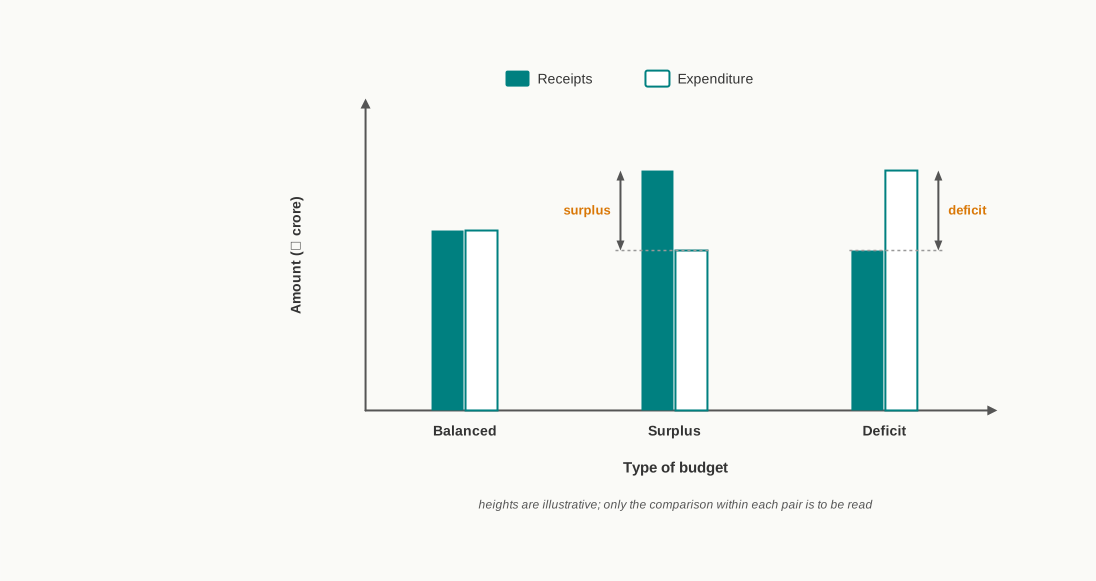
The second classification looks inside a single budget and compares its two sides. Write \(R\) for the total receipts estimated in the budget and \(E\) for the total expenditure proposed in it, both measured in rupees and both taken for the same financial year. The three possible positions are then written as follows.
\[R = E \quad \text{(balanced)} \qquad R > E \quad \text{(surplus)} \qquad R < E \quad \text{(deficit)}\]
Here \(R\) and \(E\) are totals for the whole budget, not for any one head within it. What the comparison reveals is not how large the government is, but the direction in which its budget pushes the economy.
Balanced Budget A balanced budget is one in which the estimated receipts of the government are exactly equal to its proposed expenditure for the financial year.
Surplus Budget A surplus budget is one in which the estimated receipts of the government exceed its proposed expenditure for the financial year.
Deficit Budget A deficit budget is one in which the estimated receipts of the government fall short of its proposed expenditure for the financial year, so that the gap has to be met by borrowing.
The three positions are compared in Fig. 17.3.
Effect On The Level Of Activity
The relation between the two sides is not merely arithmetic. Government receipts are a leakage from the circular flow of income, since they take purchasing power out of the hands of households and firms, while government expenditure is an injection, since it puts purchasing power back.
A surplus budget therefore withdraws more than it returns. Aggregate demand falls and the level of income, output and employment contracts. A deficit budget returns more than it withdraws, aggregate demand rises and the level of activity expands. A balanced budget, taking out as much as it puts back, is broadly neutral between the two.
This is why the choice among the three is a policy choice rather than a matter of good housekeeping. When demand is running ahead of what the economy can produce and prices are rising, a surplus budget is the appropriate instrument, because contracting demand is precisely what is wanted. When demand is deficient and workers are idle, a deficit budget is the appropriate instrument for the opposite reason. There was a time when a surplus was treated as the mark of a well-managed government; in the modern economy, where the budget is used to steer the level of activity, the deficit budget has become the ordinary case.
In the accounts, total receipts always equal total expenditure, because borrowing is counted in. A budget is called deficit when spending exceeds the receipts other than borrowing.
17.4 Components of the Government Budget
A budget that merely listed every rupee coming in and every rupee going out would tell the reader very little. Two payments of the same size can mean quite different things. Money spent on the salaries of clerks is gone by the end of the year, while the same sum spent on a bridge leaves behind something that will serve the economy for decades. Borrowing to meet the first is a very different matter from borrowing to meet the second.
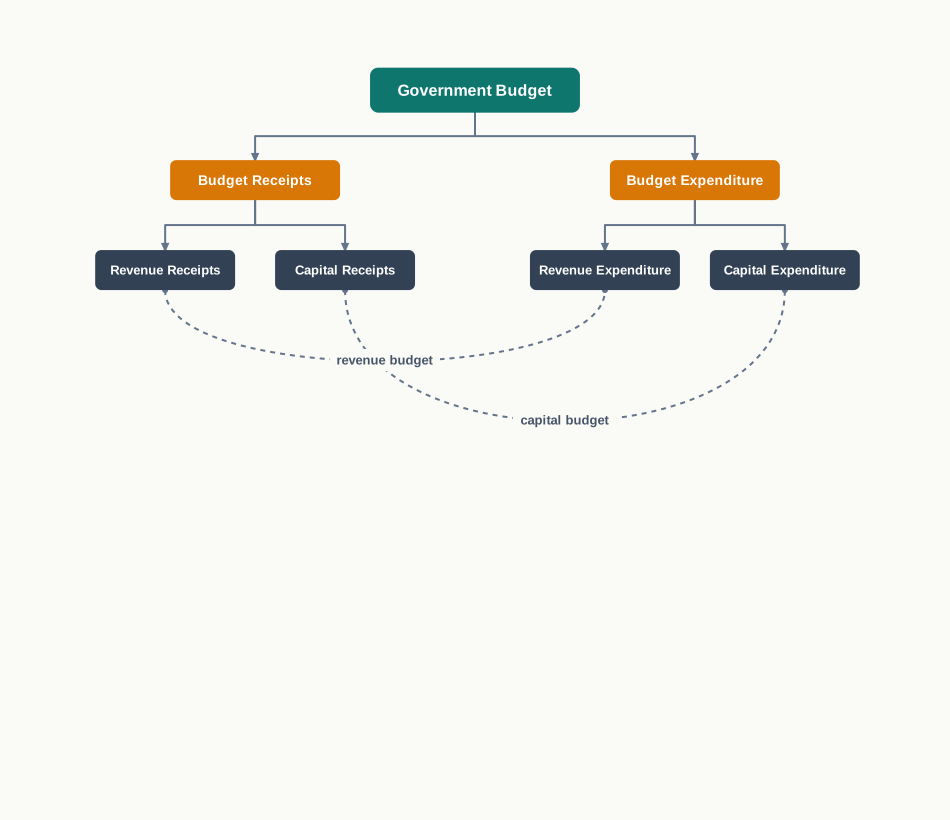
For this reason the Constitution requires that the budget keep the revenue account separate from the capital account. The budget is accordingly presented in two parts — the revenue budget and the capital budget — and since each part has a receipts side and an expenditure side, the document as a whole falls into the four parts shown in Fig. 17.4.
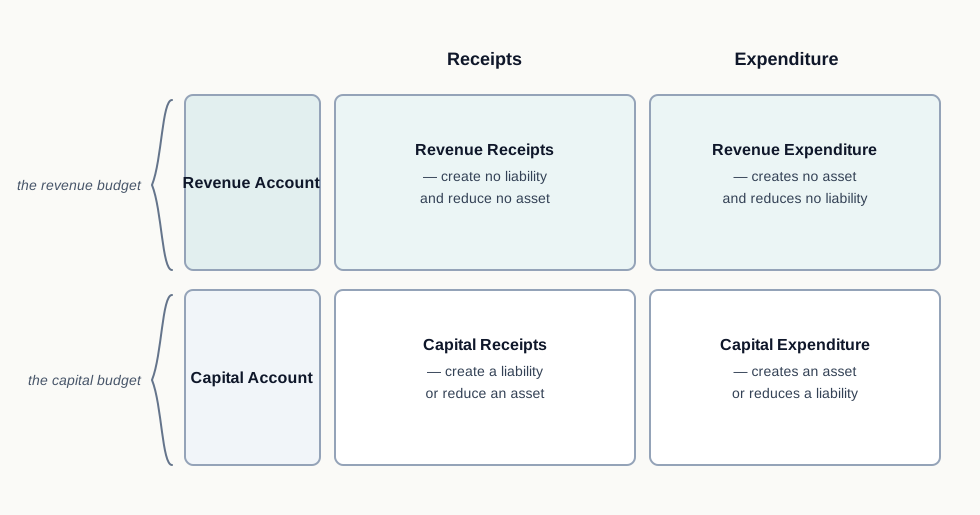
‘Revenue’ here names an account, not an inflow. The revenue budget has an expenditure side too, and the capital budget has a receipts side.
The Test That Divides Them
What decides the part in which an item belongs is neither its size nor its name, but a single question: does the item alter the government’s stock of assets or its stock of liabilities?
- On the receipts side — a receipt belongs to the capital account if it creates a liability for the government or reduces the government’s assets. A loan raised from the public creates a liability, because it has one day to be repaid. The sale of a company owned by the government reduces an asset, because the government no longer owns it. A receipt that does neither of these belongs to the revenue account.
- On the expenditure side — an item of expenditure belongs to the capital account if it creates an asset for the government or reduces the government’s liabilities. Building a highway creates an asset. Repaying the principal of a past loan reduces a liability. An item of expenditure that does neither belongs to the revenue account.
A second test, closely related to the first, is often applied alongside it. Items on the revenue account recur: salaries are paid, interest falls due and taxes are collected year after year, so long as the government exists. Items on the capital account do not recur in the same way, since a bridge is built once and a loan is raised once and repaid once.
17.4.1 The Revenue Budget
The revenue budget deals with the ordinary, year-to-year running of the government. On the receipts side it collects revenue receipts — the taxes and the earnings that come in without the government promising to repay anything or parting with anything it owns. On the expenditure side it meets revenue expenditure — the salaries, pensions, subsidies and interest payments that keep the machinery of the state working but leave the government owning no more than it did before.
Revenue Budget The revenue budget shows the revenue receipts of the government and the expenditure met from those revenue receipts. It therefore consists of two parts, revenue receipts and revenue expenditure.
The revenue budget is the part that a citizen feels most directly, because it is where taxes are levied and where subsidies, salaries and pensions are paid out. It is also the part that is watched most closely, because expenditure here leaves nothing behind. When revenue expenditure exceeds revenue receipts the government is borrowing to meet its own running costs, and the gap that measures this is taken up in 17.7.
Grants That Build Assets For Someone Else The Union Budget carries a separate line for grants in aid given to the states for the creation of capital assets. The money builds roads, hospitals and irrigation works — but it builds them for the states, not for the centre. Because the centre acquires no asset and sheds no liability, the item is classed as revenue expenditure in the Union Budget, even though the state receiving it records capital expenditure.
17.4.2 The Capital Budget
The capital budget deals with the government’s assets and liabilities rather than its running costs. On the receipts side it records capital receipts — the borrowings the government raises and the proceeds of assets it sells or loans it recovers. On the expenditure side it records capital expenditure — money laid out on land, buildings, machinery and shares, on loans granted to others, and on repaying past borrowings.
Capital Budget The capital budget comprises the capital receipts and the capital expenditure of the government. It is an account of the changes during the year in the assets and liabilities of the government.
Read together, the two parts answer two different questions. The revenue budget answers what the government’s ordinary income was and how far it covered ordinary running costs. The capital budget answers what the government built, what it sold and how much it owes at the end of the year compared with the beginning. The main points of difference are set out below.
Compare Table 17.2 — Revenue Budget And Capital Budget | Basis | Revenue Budget | Capital Budget | |—|—|—| | Meaning | Shows the revenue receipts of the government and the expenditure met from them | Shows the capital receipts of the government and the capital expenditure met from them | | Effect on assets and liabilities | Its items neither create nor reduce any asset or liability of the government | Its items either create or reduce an asset or a liability of the government | | Nature | Recurring, incurred year after year | Non-recurring, incurred as and when required | | Examples of receipts | Tax revenue, interest receipts, dividends and profits | Borrowings, recovery of loans, proceeds from the sale of government holdings | | Examples of expenditure | Salaries, pensions, subsidies, interest payments | Construction of roads and buildings, purchase of machinery, repayment of loans |
Classify by the test, not by the size of the item. Ask only whether it creates or reduces an asset or a liability. A large subsidy is revenue expenditure; a small purchase of shares is capital expenditure.
17.5 Budget Receipts
Budget receipts are all the sums that come into the hands of the government during the financial year, from whatever source. The phrase covers a tax collected from a shopkeeper, interest received on a loan the government had given years earlier, the price obtained for a company it has sold and money borrowed from the public, even though these four have almost nothing else in common.
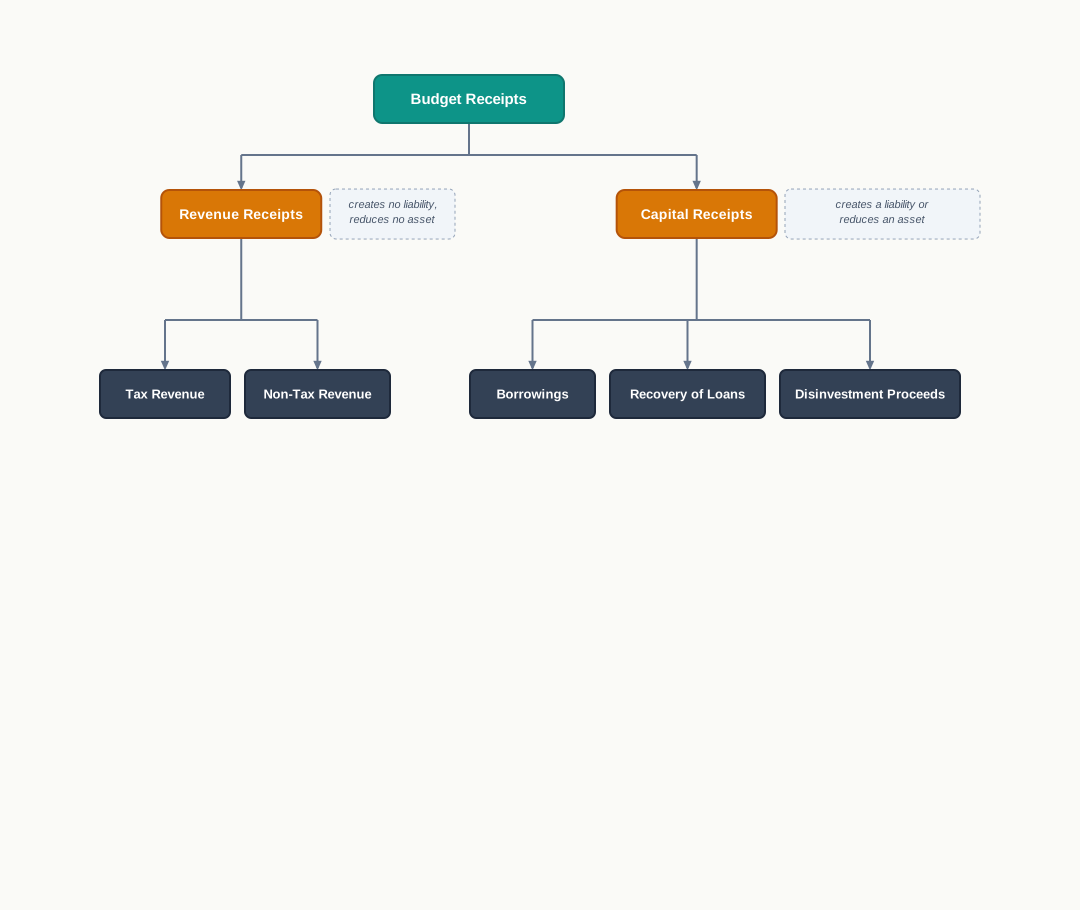
They are sorted by the test set out in 17.4. A receipt that creates a liability for the government, or that reduces something the government owns, belongs to the capital account. A receipt that does neither belongs to the revenue account. The full classification is shown in Fig. 17.5.
17.5.1 Revenue Receipts
Revenue receipts are what the government earns in the ordinary course of governing. They leave it neither owing more than before nor owning less than before, which is why they can be spent on running costs without storing up trouble for later years.
Revenue Receipts Revenue receipts are those receipts of the government which neither create a liability for the government nor cause any reduction in its assets. They are non-redeemable, that is, they carry no obligation of repayment.
Revenue receipts come under two heads, and the distinction between them is not one of size but of the ground on which the money is claimed. Under the first the government takes; under the second it earns.
17.5.1.1 Tax Revenue
A tax is the one payment a citizen makes to the state that carries no promise of anything in return. A person who pays income tax is not entitled to any particular service in exchange, and cannot ask for the money back on the ground that the roads near the house remain unbuilt. It is this element of compulsion, and the absence of a direct return, that separates a tax from every other receipt.
Tax A tax is a compulsory payment imposed by the government on individuals and companies, for which the payer receives no direct benefit in return, and which cannot lawfully be refused.
Tax revenue is by far the largest part of the government’s revenue receipts. Taxes are of two kinds. A direct tax is one whose burden falls on the same person who pays it to the government, as with income tax. An indirect tax is one whose burden can be passed on to someone else, as when a trader who pays the tax recovers it from the buyer in the price. The full comparison between the two belongs to the study of fiscal policy; here it is enough to know which of the central government’s taxes fall into each kind. The main heads are given in Table 17.1.
Table 17.1 — Main Tax Heads Of The Central Government | Tax | Levied on | Kind | |—|—|—| | Corporation tax | The profits of companies, whether registered in India or operating here from abroad | Direct | | Taxes on income | The incomes of individuals and Hindu undivided families, from salary, house property, business or profession and other sources | Direct | | Goods and services tax | The supply of goods and services within the country, at rates common across the states | Indirect | | Customs duties | Goods brought into the country, and in a few cases goods sent out of it | Indirect | | Union excise duties | Goods produced within the country, now confined largely to petroleum products and tobacco | Indirect |
17.5.1.2 Non-Tax Revenue
Everything the government receives on the revenue account otherwise than by taxation is non-tax revenue. Here the government is not exercising its power to compel but collecting what is due to it as a lender, an owner or a provider of services.
- Interest receipts — the central government lends to state governments, to union territories and to public sector undertakings, and the interest that comes back on those loans is revenue. The interest is earned income; it creates no liability and reduces no asset.
- Dividends and profits — the government owns undertakings and financial institutions, and its share of what they earn is paid over to it. The surplus transferred each year by the Reserve Bank of India is counted under this head.
- Receipts from services rendered — the government charges for a great many services. There are commercial receipts from the goods and services its enterprises sell, and administrative receipts in the form of fees, licence fees, fines and penalties. Under this head also falls escheat, the property that passes to the state when its owner dies leaving no legal heir.
- Grants in aid received — money given to the government by foreign governments and by international institutions, generally for a stated purpose such as relief after a disaster. A grant is a gift and need not be repaid, so it creates no liability and is a revenue receipt.
The Reserve Bank’s Surplus The Reserve Bank of India earns income on the government securities and the foreign assets it holds. After providing for its own reserves it transfers the surplus to the central government, where it appears in the budget under dividends and profits. The transfer creates no liability and parts with no asset, which is exactly why it is counted as a revenue receipt and not a capital one.
17.5.2 Capital Receipts
Capital receipts bring money in, but at a cost that the revenue account does not carry. Either the government has promised to repay what it has taken, or it has given up something it owned. The cash position improves; the underlying position does not.
Capital Receipts Capital receipts are those receipts of the government which either create a liability for the government or cause a reduction in its assets. Borrowings, recovery of loans and disinvestment proceeds are the main items.
- Borrowings — the largest item by far. The government raises market loans from the public, holds the money placed with it in small savings schemes and provident funds, borrows from the Reserve Bank of India, and receives external assistance from foreign governments and institutions. Every one of these has to be repaid, so each creates a liability.
- Recovery of loans and advances — the repayment of the principal on loans the centre had earlier given to state governments, union territories and public undertakings. The government’s cash rises, but a financial asset, the loan outstanding, falls by the same amount.
- Other receipts, chiefly disinvestment — the sale by the government of a part of its shareholding in a public sector undertaking. Since ownership passes to the buyer, an asset of the government is reduced.
Interest received on a loan the government has given is a revenue receipt. The principal repaid on the same loan is a capital receipt.
Read together, the two classes answer different questions about the year. Revenue receipts show what the government was able to earn; capital receipts show what it had to borrow or sell in order to make up the difference. A government whose spending is met increasingly out of the second rather than the first is living on its balance sheet. The main points of difference are set out below.
Compare Table 17.3 — Revenue Receipts And Capital Receipts | Basis | Revenue Receipts | Capital Receipts | |—|—|—| | Meaning | Receipts that neither create a liability nor reduce an asset of the government | Receipts that either create a liability or reduce an asset of the government | | Obligation to repay | None; they are non-redeemable | Borrowings must be repaid, with interest | | Nature | Recurring, received year after year from the same sources | Non-recurring, raised as and when the need arises | | Examples | Corporation tax, goods and services tax, interest receipts, dividends and profits | Market loans, small savings, recovery of loans, disinvestment proceeds |
Classification questions want the reason, not the label. ‘Disinvestment is a capital receipt because it reduces assets owned by the government’ earns the mark; naming the class without the test does not.
17.6 Budget Expenditure
Budget expenditure is the estimated spending of the government during the financial year under all its heads. It is the side of the budget that decides what the government will actually do, since a policy without money behind it changes nothing.
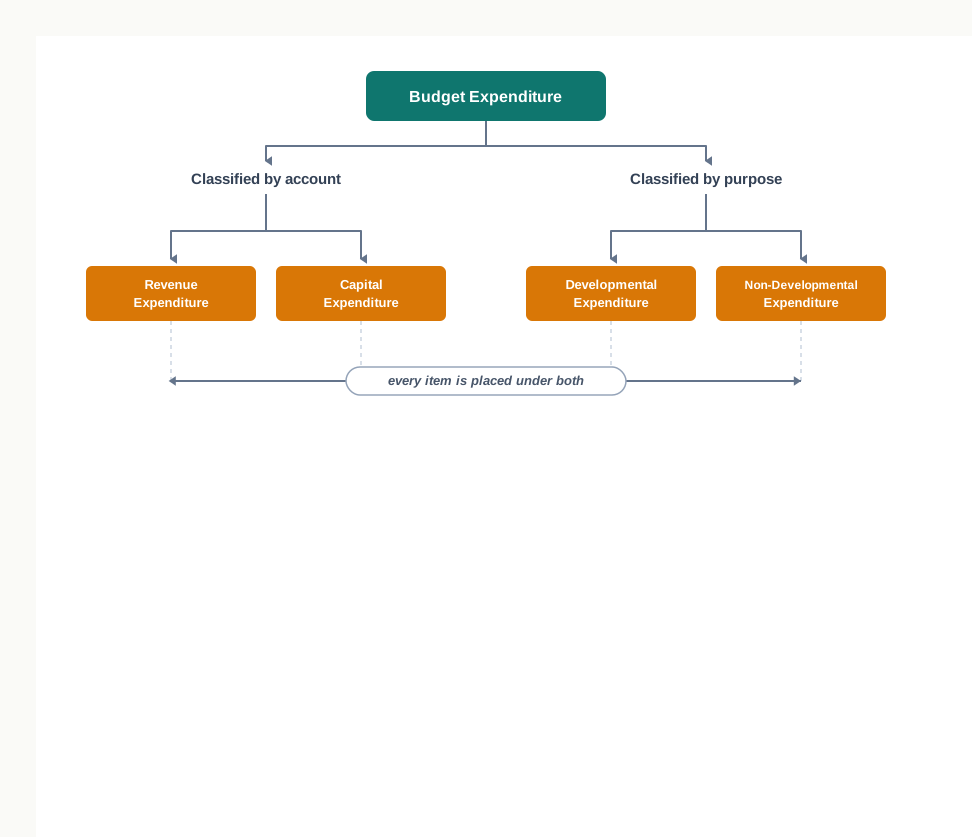
Expenditure is classified in two ways, and the two are not alternatives. The first asks what the spending does to the government’s assets and liabilities, and divides expenditure into revenue and capital. The second asks what the spending is for, and divides it into developmental and non-developmental. Every item of expenditure has a place under both classifications at once, as Fig. 17.6 shows.
17.6.1 Revenue Expenditure
Revenue expenditure is what it costs to keep the state running for a year. Teachers must be paid, hospitals supplied, pensions met, and interest handed over on debt incurred long ago. None of this leaves the government owning anything it did not own before, and none of it reduces what the government owes. When the year ends, the money is simply gone.
Revenue Expenditure Revenue expenditure is expenditure which neither creates any asset for the government nor causes any reduction in its liabilities. It relates to the normal running of government departments and the provision of government services.
The main items are these.
- Salaries and pensions — the cost of the people through whom the government works, both those in service and those retired from it.
- Interest payments — the interest falling due each year on the government’s accumulated borrowing. This is a charge that must be met before anything else can be considered, and it buys the economy nothing new.
- Subsidies — the difference the government meets when a good or service is supplied to the public below the cost of providing it, as with food, fertiliser and cooking fuel.
- Grants to state governments — sums given to the states which the centre will not get back, whether for their running costs or for assets they will own themselves.
- Maintenance and general services — the running cost of defence, police, law courts and administration, together with the upkeep of assets already built.
What Interest Costs The Budget Interest on past borrowing has become one of the largest single items in the Union Budget. In 2023–24 interest payments came to about ₹10.6 lakh crore, close to a third of the central government’s entire revenue expenditure. Every rupee of it settles a claim arising from spending done in earlier years, which is why a government that borrows heavily narrows the choices open to it later.
17.6.2 Capital Expenditure
Capital expenditure works on the government’s balance sheet rather than on its running costs. It either adds something to what the government owns or takes something off what the government owes.
Capital Expenditure Capital expenditure is expenditure which either creates an asset for the government or causes a reduction in its liabilities. It covers spending on physical and financial assets, loans granted by the government and repayment of the principal of past loans.
- Acquisition of physical assets — land, buildings, machinery and equipment, and the construction of roads, bridges, railway lines, ports and irrigation works.
- Acquisition of financial assets — the purchase of shares in undertakings and institutions, which gives the government an ownership it did not have before.
- Loans and advances granted — sums lent to state governments, union territories and public sector undertakings. The money leaves the treasury, but the loan outstanding is an asset of the government.
- Repayment of loans — the return of the principal of borrowings raised earlier. Nothing is acquired, but a liability is extinguished, and that is enough to place the item on the capital account.
The distinction matters for judging a deficit as much as for keeping accounts. Borrowing to build a port is not the same act as borrowing to pay salaries, because the first leaves behind something that will help repay the loan and the second does not. The main points of difference are set out below.
Compare Table 17.4 — Revenue Expenditure And Capital Expenditure | Basis | Revenue Expenditure | Capital Expenditure | |—|—|—| | Effect on assets | Creates no asset for the government | Creates an asset, or acquires one | | Effect on liabilities | Reduces no liability of the government | Reduces a liability, as when a loan is repaid | | Nature | Recurring, incurred year after year | Non-recurring, incurred as and when required | | Examples | Salaries, pensions, interest payments, subsidies, grants to states | Construction of roads and buildings, purchase of shares, loans granted, repayment of loans |
Watch the pairs that look alike. Interest paid is revenue expenditure but repayment of the principal is capital; a loan given by the government is capital expenditure but a grant given is revenue.
17.6.3 Developmental and Non-Developmental Expenditure
The second classification asks a different question. Instead of looking at the balance sheet, it asks whether the spending adds directly to the economic and social development of the country.
Developmental Expenditure Developmental expenditure is expenditure incurred on activities directly related to the economic and social development of the country, such as agriculture, industry, transport, education and health.
Non-Developmental Expenditure Non-developmental expenditure is expenditure incurred on the essential general services of the state, such as defence, police, administration, interest payments and pensions, which do not directly add to development.
Developmental expenditure raises the economy’s capacity to produce, or improves the quality of the people who work in it. Non-developmental expenditure does neither, but it cannot be dispensed with on that account. A country without courts, police or defence would not be able to carry on production at all, so this spending is better understood as the price of the order within which development becomes possible.
Because the two classifications cut across each other, an item has to be placed under both. Table 17.2 gives an example in each of the four positions.
Table 17.2 — Expenditure Classified By Account And By Purpose | Purpose | On revenue account | On capital account | |—|—|—| | Developmental | Salaries of teachers and doctors; running costs of agricultural extension services | Construction of irrigation works, power stations and rural roads | | Non-developmental | Interest payments; pensions; expenditure on police and administration | Purchase of defence equipment; repayment of the principal of past loans |
Capital expenditure is not the same as developmental expenditure. Defence equipment is bought on the capital account, yet it is non-developmental.
The proportion between the two is watched closely, because it indicates how much of a year’s spending is going into the future of the economy and how much into holding the present together. A government whose non-developmental expenditure grows year after year, chiefly through rising interest and pension obligations, finds the developmental share squeezed even when the total budget is expanding.
17.7 Types of Budget Deficit
A deficit is what remains when a government’s proposed spending is set against the money it can raise without borrowing. The gap has to be filled, and it can only be filled by borrowing, so the size of the deficit is also the size of the year’s borrowing.
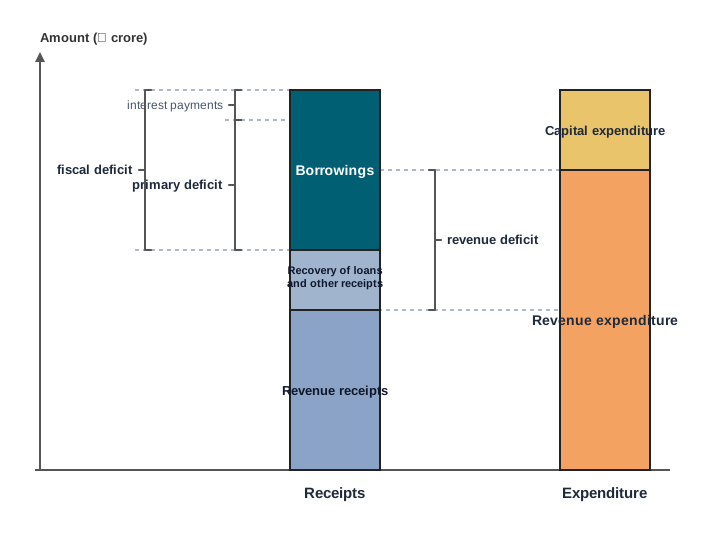
That much is simple. What is not simple is deciding which receipts to count on the other side of the comparison, and the answer differs according to what one wants to know. A reader asking whether the government can pay its running costs out of its ordinary income will leave out borrowing and asset sales alike. A reader asking how much the government must borrow this year will count everything except the borrowing itself. A reader asking whether this year’s government has been prudent will want the interest inherited from earlier years taken out first. Three questions, three measures. India’s budget reports all three, and they are shown together in Fig. 17.7.
17.7.1 Revenue Deficit
The revenue deficit looks only at the revenue budget. It asks whether the government’s ordinary income for the year covered the ordinary cost of running the state, and ignores the capital account entirely.
Revenue Deficit Revenue deficit is the excess of the revenue expenditure of the government over its revenue receipts during a financial year.
The measure compares the two sides of the revenue budget. It is written as the amount by which the expenditure side exceeds the receipts side.
\[\text{Revenue Deficit} = \text{Revenue Expenditure} - \text{Revenue Receipts}\]
Here revenue expenditure and revenue receipts are the totals of the revenue budget for the year, both measured in ₹ crore. A positive result means the government could not meet its running costs out of its earnings; a result of zero means the two exactly matched; a negative result is a revenue surplus, which leaves something over for investment.
The implications follow from what the borrowed money was used for.
- Dissaving by the government — a household that borrows to buy groceries is running down its position, and a government in the same case is doing the same thing. It is consuming more than it earns.
- Borrowing that leaves nothing behind — the loans raised to cover a revenue deficit are spent on salaries, subsidies and interest, so no asset is created against which the debt can later be serviced.
- A deficit that feeds itself — the borrowing adds to debt, the debt adds to next year’s interest, and interest is itself revenue expenditure. Unless corrected, the deficit tends to widen of its own accord.
- Pressure on prices — money borrowed and spent on consumption adds to demand without adding anything to the economy’s capacity to supply.
Prudence therefore requires that revenue expenditure be held below revenue receipts, so that the revenue account shows a surplus and borrowing can be reserved for building assets.
17.7.2 Fiscal Deficit
The fiscal deficit is the comprehensive measure, and the one by which a government’s finances are ordinarily judged. It asks how much the government must borrow during the year, counting every receipt that is not itself a borrowing.
Fiscal Deficit Fiscal deficit is the excess of the total expenditure of the government over its revenue receipts and those capital receipts which are not borrowings, during a financial year.
The receipts counted on the other side are the government’s own income — what it earns, what it recovers on past loans and what it realises by selling assets. Borrowings are excluded, because they are the very thing being measured.
\[\text{Fiscal Deficit} = \text{Total Expenditure} - (\text{Revenue Receipts} + \text{Recovery of Loans} + \text{Other Receipts})\]
Here total expenditure is the sum of revenue and capital expenditure, recovery of loans is the principal received back on loans the government had given, and other receipts are chiefly the proceeds of disinvestment. All are in ₹ crore for the year. The result is read directly as the government’s total borrowing requirement for that year.
- It measures the total borrowing requirement — the fiscal deficit is not merely related to borrowing, it is equal to it. Market loans, small savings, provident funds, borrowing from the Reserve Bank and external assistance together make up exactly this figure.
- It shows the extent of living beyond one’s means — the deficit is the amount by which the year’s spending exceeded everything the government could raise on its own account.
- It carries the risk of a debt trap — the borrowing raises next year’s interest bill, which raises next year’s expenditure, which requires further borrowing. A government caught in this circle is borrowing largely in order to service what it has already borrowed.
- It may crowd out private investment — the government competes with firms for the savings of the community. What it pre-empts is not available to private borrowers, and the cost of borrowing rises for everyone.
- It may add to inflation — where the deficit is financed by borrowing from the central bank, money supply expands without a matching rise in output.
- It shifts a burden forward — the loans of this year are repaid, with interest, out of the taxes of later years, by people who had no part in the decision to borrow.
Fiscal deficit is total expenditure less revenue receipts less non-debt capital receipts. Answers that subtract total receipts get zero, because total receipts include borrowings. Name the excluded item explicitly.
Fiscal deficit is the borrowing of one year. It is not the government’s total debt, which is the accumulation of all the deficits of the past.
17.7.3 Primary Deficit
Part of the fiscal deficit is not the doing of the present government at all. Interest has to be paid on loans raised by its predecessors, and that obligation would exist even if this year’s ministers spent nothing beyond their income. The primary deficit removes it, so that what remains reflects the borrowing incurred for the current year’s own purposes.
Primary Deficit Primary deficit is the difference between the fiscal deficit of the government and the interest payments it makes on its past borrowings during a financial year.
\[\text{Primary Deficit} = \text{Fiscal Deficit} - \text{Interest Payments}\]
Both terms are in ₹ crore for the year, and interest payments are those falling within revenue expenditure. The result is read as the borrowing the government needs for everything other than servicing old debt.
- It isolates the present from the past — a large fiscal deficit accompanied by a small primary deficit tells the reader that the trouble is inherited rather than newly created.
- It is a measure of current fiscal discipline — because it is the part of the deficit the government of the day can actually control, a fall in the primary deficit is the clearest sign that the finances are being brought into order.
- A zero primary deficit is a meaningful landmark — it means the government is borrowing no more than what it needs to meet interest, and is adding nothing fresh to the pile.
The Three Deficits In One Year The accounts for 2023–24 show all three measures together for the central government. The revenue deficit stood at about 2.6 per cent of gross domestic product, the fiscal deficit at about 5.6 per cent and the primary deficit at about 2.0 per cent. The gap between the fiscal and the primary figure is the interest bill, and its size shows how much of that year’s borrowing was owed to the borrowing of earlier years.
The three measures are best held apart by remembering what each leaves out. The main points of difference are set out below.
Compare Table 17.5 — Revenue Deficit, Fiscal Deficit And Primary Deficit | Basis | Revenue Deficit | Fiscal Deficit | Primary Deficit | |—|—|—|—| | Meaning | Excess of revenue expenditure over revenue receipts | Excess of total expenditure over revenue receipts and non-debt capital receipts | Fiscal deficit less interest payments on past borrowing | | Account covered | The revenue account alone | The revenue and capital accounts together | The revenue and capital accounts, with interest removed | | What it indicates | That running costs are not being met out of ordinary income | The total borrowing the government must undertake during the year | The borrowing required for purposes other than servicing old debt | | Relation to the others | A part of the fiscal deficit | The widest of the three measures | The fiscal deficit stripped of its inherited element |
17.8 Summary
- A government budget is an annual financial statement showing the estimated receipts and the proposed expenditure of the government under various heads for the financial year, which in India runs from 1 April to 31 March.
- The budget is a constitutional obligation and not merely a convention. Article 112 requires the annual financial statement to be laid before Parliament, and no sum may be raised or spent until the legislature has voted it.
- The main features of a budget are that it is annual, that its figures are estimates and not accounts, that it sets receipts against expenditure in one document, that it has no force until the legislature approves it, and that it states the government’s fiscal policy in figures.
- Every budget document carries three sets of figures at once.
- Budget estimates — the receipts and expenditure proposed for the coming year, and the part the legislature votes upon.
- Revised estimates — the corrected figures for the year now running.
- Actuals — the audited accounts of the last year whose books have been closed.
- The economic objectives of the budget are the reallocation of resources, the redistribution of income and wealth, economic stability, the management of public enterprises, economic growth and the reduction of regional disparities.
- Its administrative objectives are a planned approach to government activity, an integrated treatment of decisions on taxing, borrowing and spending, public accountability to the legislature, and a standing record against which the government’s performance can be judged.
- Budgets are classified first by the layer of government preparing them. The Union Budget is prepared by the central government and laid before Parliament under Article 112; a state budget is prepared by a state government and laid before that state’s legislature under Article 202.
- Budgets are classified second by the relation between their two sides, where \(R\) is total estimated receipts and \(E\) is total proposed expenditure, both in ₹ crore for the year.
- Balanced budget — \(R = E\), broadly neutral in its effect on the level of activity.
- Surplus budget — \(R > E\), withdrawing more purchasing power than it returns and so contracting activity, which suits a period of inflation.
- Deficit budget — \(R < E\), returning more than it withdraws and so expanding activity, which suits a period of recession.
- The budget is presented in two parts, the revenue budget and the capital budget. What places an item in one or the other is a single test — whether it alters the government’s stock of assets or its stock of liabilities.
- Revenue receipts create no liability for the government and reduce none of its assets. They fall under two heads.
- Tax revenue — a tax being a compulsory payment for which the payer receives no direct return. The main central taxes are corporation tax, taxes on income, the goods and services tax, customs duties and union excise duties.
- Non-tax revenue — interest receipts, dividends and profits, receipts from services rendered including fees, fines and escheat, and grants in aid received.
- Capital receipts either create a liability or reduce an asset. The main items are borrowings of every kind, recovery of loans and advances, and other receipts, chiefly the proceeds of disinvestment.
- Budget expenditure is classified by account under the same test.
- Revenue expenditure creates no asset and reduces no liability — salaries, pensions, interest payments, subsidies and grants to state governments.
- Capital expenditure creates an asset or reduces a liability — construction of physical assets, purchase of shares, loans granted to others, and repayment of the principal of past loans.
- Expenditure is classified a second time by purpose. Developmental expenditure is incurred on activities directly related to the economic and social development of the country; non-developmental expenditure is incurred on the essential general services of the state. The two classifications cut across each other, so every item is placed under both.
- Revenue deficit is the excess of revenue expenditure over revenue receipts, \(\text{Revenue Deficit} = \text{Revenue Expenditure} - \text{Revenue Receipts}\), where both terms are totals of the revenue budget in ₹ crore. It means the government is borrowing to meet its own running costs, and is therefore dissaving.
- Fiscal deficit is the excess of total expenditure over revenue receipts and those capital receipts that are not borrowings, \(\text{Fiscal Deficit} = \text{Total Expenditure} - (\text{Revenue Receipts} + \text{Recovery of Loans} + \text{Other Receipts})\), all in ₹ crore. It is equal to the government’s total borrowing requirement for the year.
- A large fiscal deficit carries the risk of a debt trap, in which fresh borrowing is required largely to service old borrowing, and it may also crowd out private investment and add to inflationary pressure.
- Primary deficit is the fiscal deficit less the interest paid on past borrowing, \(\text{Primary Deficit} = \text{Fiscal Deficit} - \text{Interest Payments}\), in ₹ crore. It measures the borrowing needed for purposes other than servicing old debt, and is the part of the deficit that the government of the day can control.
The distinction that runs through the whole chapter is the one between the revenue account and the capital account. It is condensed below.
Compare Table 17.6 — The Revenue And Capital Test Applied To Both Sides Of The Budget | Basis | Revenue Account | Capital Account | |—|—|—| | Receipts | Create no liability and reduce no asset — taxes, interest receipts, dividends and profits, grants in aid received | Create a liability or reduce an asset — borrowings, recovery of loans, disinvestment proceeds | | Expenditure | Creates no asset and reduces no liability — salaries, pensions, subsidies, interest payments, grants to states | Creates an asset or reduces a liability — construction, purchase of shares, loans granted, repayment of loans | | Nature | Recurring, incurred and received year after year | Non-recurring, incurred and raised as and when required |
17.9 Points to Ponder
- A household that borrows every year to pay for its groceries is thought imprudent, and much the same is said of a government that runs a revenue deficit. But a government does not die, it can raise taxes, and a great deal of what it spends becomes the income out of which its citizens pay those taxes. How far does the household analogy really hold, and at what point does it begin to mislead?
- A government can reduce its fiscal deficit in a given year by selling part of its shareholding in a public sector undertaking, since disinvestment proceeds are counted among the receipts set against expenditure. After the sale, however, it owns less than it did before. Is a deficit target that can be met by selling assets a satisfactory test of how a government has managed its finances?
- Money spent on building a school is capital expenditure and money spent on paying its teachers is revenue expenditure, yet over forty years the second may add more to the country’s productive capacity than the first. Should the definition of an asset in a government budget be widened to take in the capacities built up in people, and what would be lost if it were?
- Government borrowing absorbs savings that private firms might otherwise have borrowed and invested, which is the argument for saying that a large fiscal deficit crowds private investment out. But a road or a power station built with that borrowing may make private investment more profitable than it would otherwise have been. Under what conditions would you expect the second effect to outweigh the first?
- The primary deficit is defended on the ground that a government should not be judged on interest arising from decisions taken before it came to office. Yet the same government inherits the roads, plants and institutions that the earlier borrowing paid for. Is it consistent to set the inherited liability aside while keeping the benefit of the inherited asset?
- A rule fixing an upper limit on the fiscal deficit as a proportion of national income is meant to impose discipline on governments. But in a recession tax collections fall and relief spending rises, so the deficit widens at exactly the moment when a deficit is most useful in supporting demand. Should such a rule bind in a slump, and if it should not, who ought to decide when it is relaxed?
17.10 Objective Questions
- Which of the following is a capital receipt of the government? [1]
- Corporation tax collected from companies
- Interest received on a loan given to a state government
- Recovery of the principal of a loan given to a state government
- Dividend received from a public sector undertaking
- Read the Assertion (A) and the Reason (R) given below and choose the correct option. [1] Assertion (A): Repayment of the principal of a past loan is treated as capital expenditure. Reason (R): Repayment of a loan reduces a liability of the government.
- Both Assertion (A) and Reason (R) are true, and Reason (R) is the correct explanation of Assertion (A)
- Both Assertion (A) and Reason (R) are true, but Reason (R) is not the correct explanation of Assertion (A)
- Assertion (A) is true, but Reason (R) is false
- Assertion (A) is false, but Reason (R) is true
- Fill in the blank. The excess of the total expenditure of the government over its revenue receipts and its capital receipts other than borrowings is called the __________ deficit. [1]
- State whether the following statement is true or false. Grants given by the central government to a state government for the creation of capital assets are treated as capital expenditure in the Union Budget. [1]
- Match each item in Column I with the head under which it is classified in Column II. [1]
| a. Escheat |
i. Capital receipt |
| b. Market loan raised from the public |
ii. Revenue expenditure |
| c. Interest paid on past borrowing |
iii. Non-tax revenue |
17.11 Check Your Concepts
- Define primary deficit, and state what it measures that the fiscal deficit does not. [2]
- Distinguish between revenue receipts and capital receipts, giving one example of each. [3]
- A grant given by the central government to a state government is treated as revenue expenditure, while a loan given to the same state government is treated as capital expenditure. Explain the reason for the difference in treatment. [4]
- Distinguish between revenue deficit, fiscal deficit and primary deficit, and explain one implication of each for the economy. [6]
17.12 Case-Based Question
- Meera Raghavan, the finance secretary of a state government, is preparing the budget for the coming year. She finds that the salary and pension bill has risen sharply and that interest on the state’s past borrowing is now a heavy charge on the revenue account, so that the state’s ordinary income will not cover these two items alone. To close the gap she proposes two measures — raising a fresh market loan from the public, and selling the state’s shareholding in Sarita Cements Limited, an undertaking it has owned for many years.
- Classify each of the two measures Meera proposes as a revenue receipt or a capital receipt, giving a reason in each case. [2]
- Name the deficit that arises when a government’s ordinary income fails to cover its running costs, and explain why economists regard such a deficit as more troubling than borrowing undertaken to build a canal. [2]